Omakase has been the thing to book in London for the best part of three years now, and we’ve covered a fair few of them in these pages. What’s been curiously absent from all this, though, is a restaurant devoted purely to sushi. Everything else – the tempura interludes, the wagyu flourishes, the theatrical blowtorch – has rather overtaken the thing itself, such that sushi, done properly, has become the dish omakase forgot. It’s ubiquitous, denigrated to supermarket shelves, all-you-can-eat buffets and conveyor belts, and therein lies the problem: ubiquity is the natural enemy of art.
Sushi, done as an art form – reverential, its execution close to ritual, its components superlative – has, at 45 Park Lane, found its gallery. Kanesaka is the first European outpost of Shinji Kanesaka, whose original in Tokyo’s Ginza has held two Michelin stars since 2018 and whose training, at the legendary Kyubey, produced a lineage of chefs that now reads like a culinary Who’s Who of Tokyo. The London restaurant opened in 2023, just thirteen seats in a discreet upstairs room at the hotel, and picked up its own Michelin star within seven months of opening.
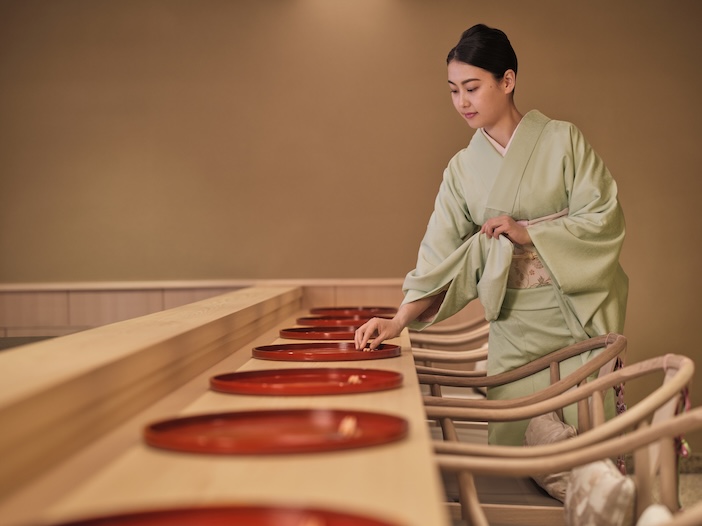
The experience begins before we’ve set foot in the restaurant proper. We’re met in the lobby by Nanami-san, our okami, or host – though the word undersells it – in a shimmering jade kimono, the embodiment of omotenashi, the philosophy of hospitality practised so subtly you barely notice it happening. Glasses are topped up, utensils placed, direction given with nothing more than a gesture; if we’re offered something, it’s proffered demurely, almost apologetically. Precision governs everything here, not just the room’s clean-lined cedar and Kumiko panelwork, but its choreography; the placement of a coaster, the position of a glass, all of it deliberate.
We’re in for twenty courses, though it’s more like a continuous rhythm of service. As such, the menu, printed on parchment, its dishes listed in phonetic Japanese, is presented after the meal, not before. That’s telling. We are, truly, in chef’s hands. His English is limited, so what he can’t tell us in the moment, we look up later; this may be the first tasting menu I’ve enjoyed more in retrospect, once each dish has revealed what it was actually doing.
First movements
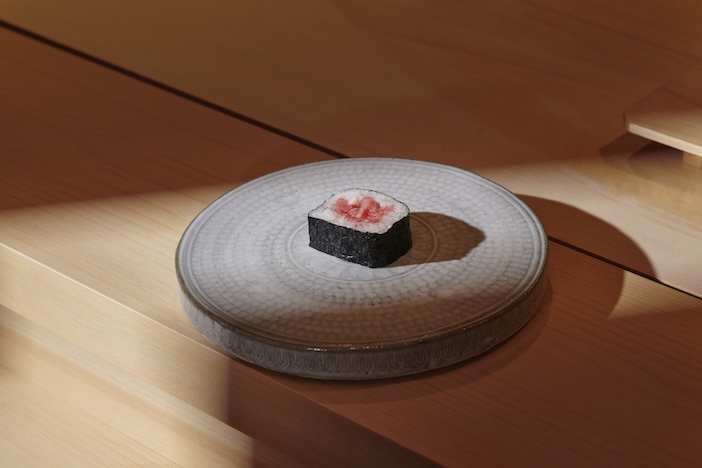
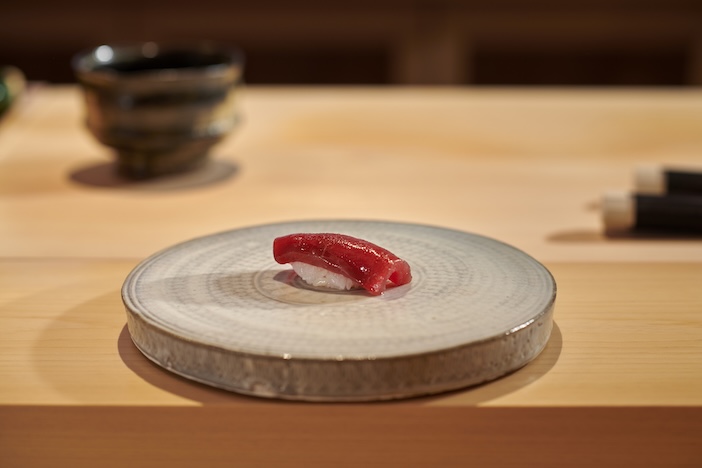
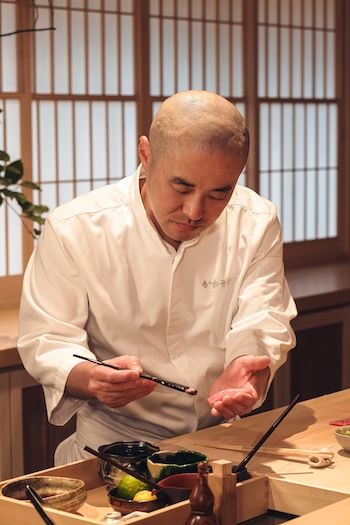 We open with king crab and junsai, a cold and translucent dashi laced with seaweed. It prepares the palate, essentially. Then two tuna nigiri: marinated akami, the lean, dark red flesh cut from the fish’s back, and chutoro, its medium-fatty cousin from the belly. It’s a lesson in tuna’s hierarchy; most kitchens serve one cut and call it a day, here we get the gradient. And they’re made in front of us. Watching the shokunin, the sushi chef, work is close to hypnotic: fingers moving so deftly, the flicks, the squeeze, flourishes so subtle they barely register; it’s slick, and yet nothing about it looks rushed.
I notice, too, there’s no dish of soy on the counter, no wasabi to help ourselves to. That’s the philosophy: the balance between topping, vinegared rice and wasabi is his to calibrate, not ours to adulterate with a saucer of soy and a heap of pickled ginger. At the end, he brushes soy across the fish for a glossy finish and sets the piece down himself. We’re told, somewhat surprisingly, to eat with our fingers. It dissolves before you’ve properly started chewing, and alongside a citrusy sake becomes enlivened. There’s a Japanese proverb for this: nihonshu wa ryori wo erabanai – ‘sake does not pick a fight with the food’. It’s a harmonious pairing in the truest sense.
The middle courses
The next run arrives in quick succession: octopus sunomono, boiled Cornish octopus with pickled seaweed; suzuki nigiri, seabass under an irizake sauce built on a sake emulsion; yariika, squid sushi topped with Kaviari caviar, the rice still faintly warm; and amadai shioyaki, grilled tilefish over an earthy, puréed radish.
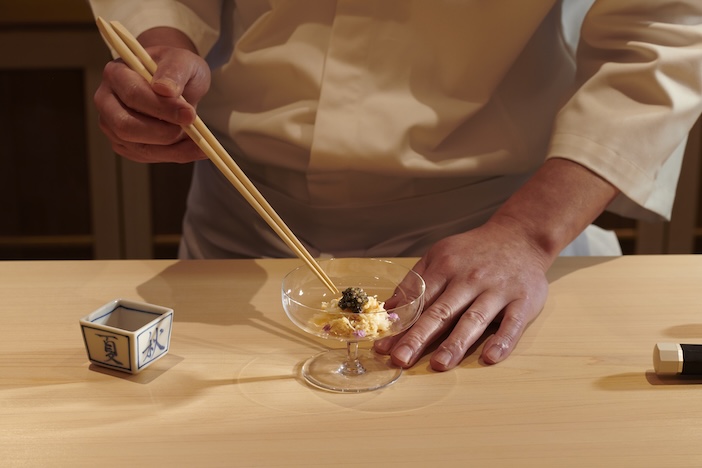
Somewhere in here the register changes, as does the sake. We’re poured something creamier, from the north, arriving alongside the fabled otoro; the fattiest, most marbled cut of tuna belly, the one sushi chefs reserve for the moment they want to make an impression. Its nigiri is noticeably meatier than the akami and chutoro before it. This is the business end of the meal, the point where a tasting menu usually calls itself a main course.
After saba, mackerel, comes the first roll: unagi kabayaki, eel with sesame and cucumber, the hinge between fish and what’s coming next; Kobe beef, steamed for three hours and set on a banana leaf carved, by hand, into a silhouette. Mine’s a turtle, with Mount Fuji rising behind it. It’s this kind of detail, and the fact each course arrives one mouthful at a time, that tips the meal from ‘very good’ into something closer to extraordinary.
Towards the end
Nine courses still to come, we’re told, which feels implausible given how much ground we’ve already covered. A sweet prawn botanebi nigiri, brightened with lime. Then the blowtorch appears, for kinmedai – golden-eye snapper, its skin lightly seared to render the fat just beneath – sourced, as it happens, from Portugal, and the disclosure is deliberate. The provenance is as significant as the order of the dishes. The rice is from Yamagata prefecture, chosen for its stickiness that somehow still melts on contact; the fish comes from European waters, prized for freshness, and prepared using the ikejime method to preserve it. It’s a small but pointed lesson; not where the fish is from, but how it’s handled once caught.
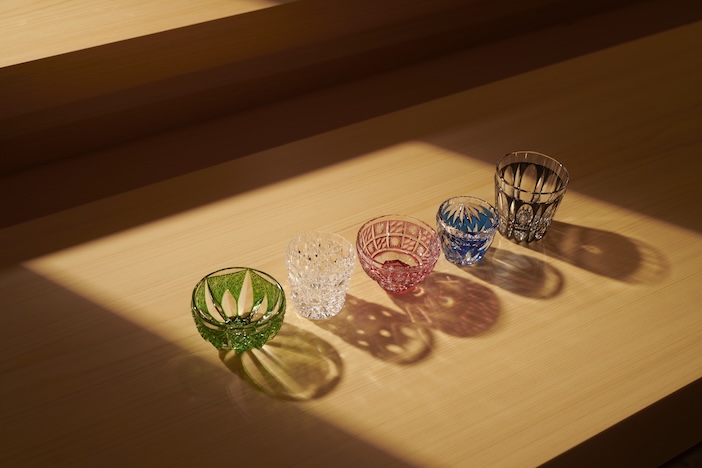
The sake changes again, and this time we’re invited to choose our own vessel, hand-cut glass from Tokyo, from a presentation box. Mine, the waitress tells me, is something special. A subtle compliment to heighten the experience. The sake is special, too; Tamagawa from Kyoto, the rice polished to fifty per cent. Punchy and deeply umami, it arrives with two pieces of tempura lobster, one to be eaten with salt, the next with sauce; it’s an instruction rather than suggestion, which by this point in the evening feels entirely in keeping. Nothing here is left to chance, least of all how you’re meant to eat it.
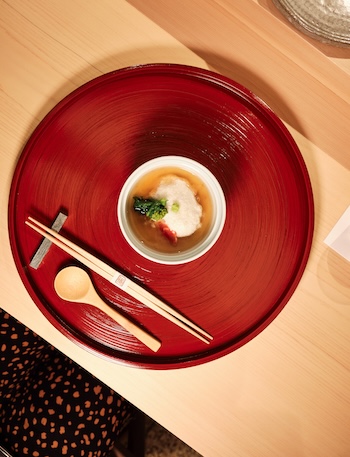 Salmon roe follows, gunkan-style, a coin-width of rice topped with ikura wrapped in seaweed. Then the final piece proper: a negitoro hand roll, tuna diced in front of us, served with Japanese leeks and pickles. The fish chapter closes on osuimono, a clear broth poured over hamaguri clam – a shellfish long treated as symbolic in Japan: each shell’s two halves fit only their original pair, which is why hamaguri turns up at weddings as a small, edible metaphor for fidelity.
Dessert, and the last word
There’s a Japanese idiom about always leaving the table a little hungry, to ward off overindulgence, and despite eighteen mouthfuls by this point, we’re satisfied rather than stuffed. Where most tasting menus leave you groaning by dessert, here we’re simply content. Dessert, then, opens with tamagoyaki, a simple cube of sweetened omelette, and a few slices of mango bring us back down to earth, before the final course: anmitsu, a beautiful bit of Japanese confectionery – small bubbles of agar jelly, mochis and mandarin served with a dark, treacly kuromitsu syrup and a spoonful of sweet red bean paste. I ask chef whether I should mix it all together. He suggests, gently, that I shouldn’t – just take it as separate spoonfuls. It brings the curtain down on what has felt like a once-in-a-lifetime experience.
Twenty courses, and not one of them considered itself as more important than the last. That, more than the Michelin star or the eye-watering bill, is what marks Kanesaka out: it’s discipline and precision over showmanship. London has no shortage of places doing omakase, all wagyu and blowtorch and theatre. Kanesaka does the opposite – it does sushi, and does it better than almost anywhere else the city, and likely the globe, has managed to.
Sushi Kanesaka at 45 Park Lane, London W1K 1PN. For more information, and for bookings, please visit www.dorchestercollection.com.