A rare exhibition at The Courtauld Gallery turns the spotlight on the coastal paintings of Georges Seurat. Rosalind Ormiston explores the shimmering seascapes that reveal the artist’s radical approach to colour and light…
Between 1885 and 1890, the French painter Georges Seurat spent his summers along the northern coast of France, choosing a different location each year. He stayed in Grandcamp, Honfleur, Port-en-Bessin, Le Crotoy and Gravelines, devoting around six weeks in each place to painting views of the Channel coastline and estuaries: landscapes, coastal houses, ships in port and sailing yachts beneath expansive skies. Seurat remarked that such trips allowed him to “cleanse one’s eyes of the days spent in the studio and translate as accurately as possible the bright light, in all its nuances.”
At The Courtauld Gallery, Seurat and the Sea offers a rare opportunity to view 26 of these seascapes, including preliminary sketches shown alongside the finished works. It is the first UK exhibition in nearly 30 years to focus solely on Seurat, and the first devoted entirely to his seascapes. The result is exceptional: a compelling insight into his life, artistic vision and meticulous technique.

Born in 1859 into a wealthy Parisian family, Seurat was able to pursue art as a profession. His father, who had a legal background, made his fortune through property speculation. Despite his later fame, Seurat was intensely private. Only a handful of close friends were admitted to his studio, and no one was permitted to watch him paint.
This reserve contrasts with his central role in developing a radical new painting method. In 1886, his friend, the critic Félix Fénéon, coined the term Neo-Impressionism to describe Seurat’s approach: the application of small dots or dashes of pure, complementary colours to create an optical reaction on the canvas. Seurat himself referred to his theoretical and practical explorations as Chromoluminarism. Others preferred “pointillism” or “divisionism”. Drawing on the colour theories of Charles Blanc, Michel-Eugène Chevreul and Ogden Rood, Seurat placed unmixed colours side by side — a red dot next to a green, for example — producing what he called “optical fusion”, a vibrant shimmer perceived in the viewer’s eye. The exhibition’s curator, Dr Karen Serres, provides a clear illustrated panel explaining this complex technique.
Unlike Seurat’s monumental figure paintings — such as Bathing, Asnières in the National Gallery and A Sunday on La Grande Jatte at the Art Institute of Chicago — his seascapes are largely devoid of people. Their absence creates a profound sense of solitude and harmony, shifting attention to coastline, architecture and harbour structures.
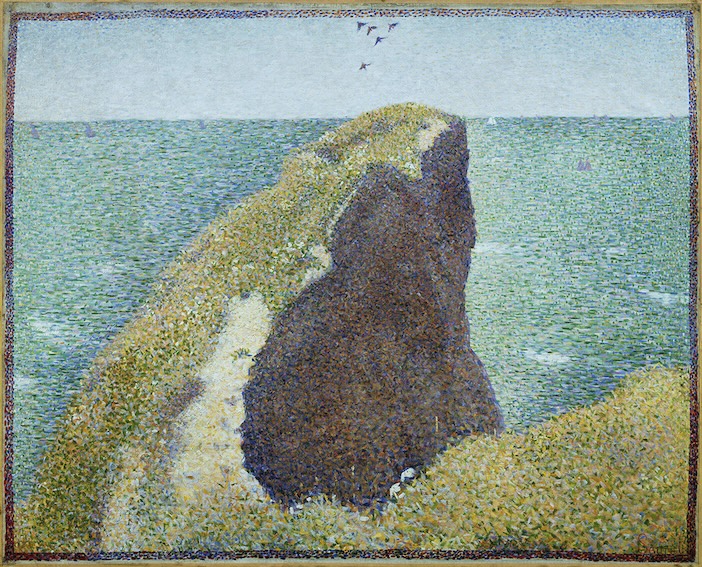
Le Bec du Hoc, Grandcamp, 1885 (Tate, London)
The exhibition opens with Le Bec du Hoc, a vast rocky cliff near Grandcamp that appears to surge upwards from the sea like a breaking wave. Japanese woodblock prints, particularly those by Katsushika Hokusai, were widely admired in Paris at the time and influenced many artists. In Seurat’s painting, the distant turquoise-green sea is rendered with delicate dashes of colour that evoke translucent water.
In Honfleur, a fashionable resort on the Seine estuary, Seurat painted works such as La Maria, Honfleur, depicting the cross-Channel vessel carrying passengers to Southampton, and Entrance to the Port of Honfleur, later reworked in the studio. A striking black-and-white preliminary study of the port, executed in Conté crayon, demonstrates his mastery of tone. Made from compressed graphite and carbon black, the crayon offered a wide range of tonal variation and, unlike charcoal, did not smudge — one reason Seurat favoured it.
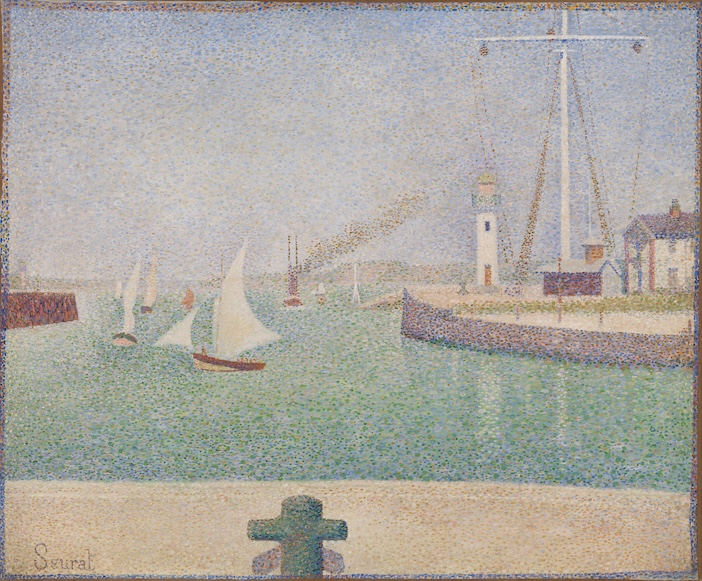
Entrance to the Port of Honfleur, 1886 (Barnes Foundation, Philadelphia)
He travelled with a compact paintbox and produced oil-on-wood sketches on small panels measuring 16 x 25 cm, designed to fit into a travelling “thumb-box” (boîte pochade) with a hole underneath for the painter’s thumb to steady it. The wooden panels slotted neatly into the open lid. This portable arrangement enabled him to work en plein air with remarkable efficiency. He rarely varied the size of these sketches, usually composing them as horizontal landscapes, occasionally in a vertical format. Some were drawn in Conté crayon to establish tonal contrasts — perhaps suggesting a darkening sky or deepening shadows — before being developed into finished oil paintings. Others were painted directly outdoors. In one study for The Channel of Gravelines, grains of sand remain embedded in the paint surface, a tangible trace of the coastal environment.
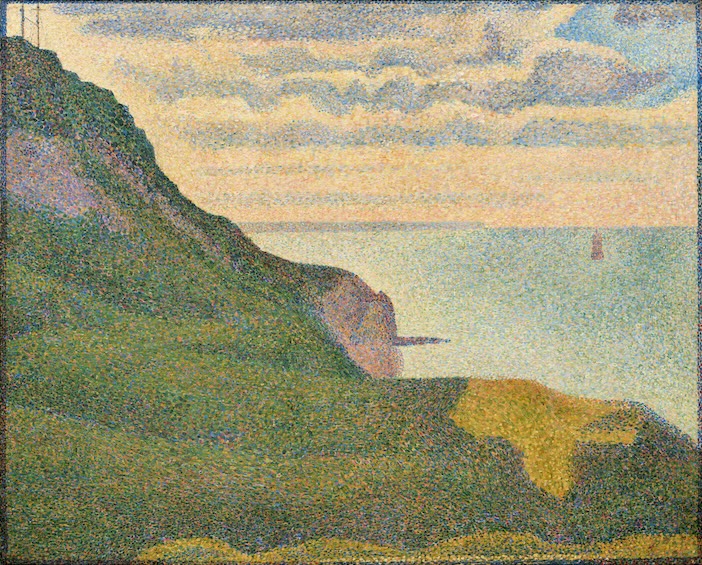
One rare seascape featuring figures is Port-en-Bessin. Here, Seurat captures the architectural geometry of the harbour at low tide, its cluster of coastal houses and wide sweep of sand extending beyond the picture plane. Thick dots of pale colour articulate sunlit stone, while cooler blues describe shadow, punctuated by flashes of orange and red. On the honeyed sands, a man, a woman and a child walk separately across the beach. This was one of only three paintings Seurat sold during his lifetime; the others — The Hospice and the Lighthouse at Honfleur and The Shore at Bas-Butin (Honfleur) — are also included in the exhibition. Nearby, nineteenth-century photographic postcards reveal how closely Seurat observed and translated the scenes before him.
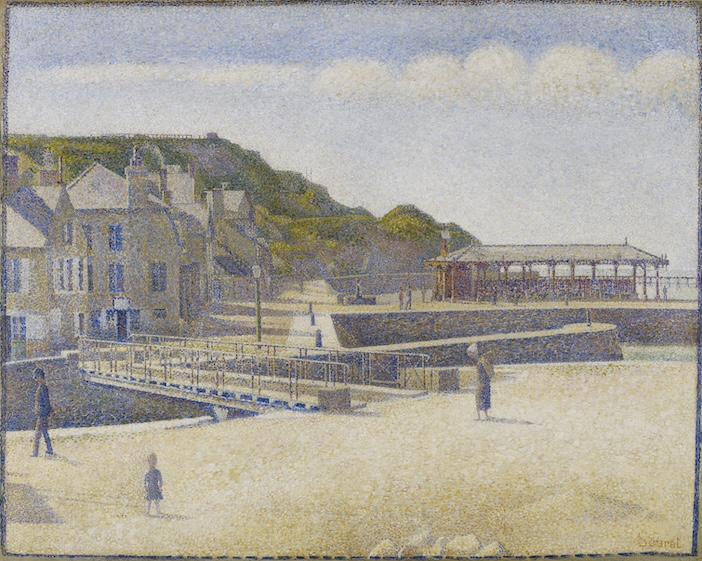
Port-en-Bessin, 1888 (lent by the Minneapolis Institute of Art, The William Hood Dunwoody Fund)
These remarkable works affirm Seurat’s artistic brilliance. Soon after completing his final summer paintings, he contracted diphtheria and died at the age of 31. Only then did his family discover that he had a long-standing relationship with Madeleine Knobloch, who had borne him a son and was pregnant with a second child. On a nearby wall at The Courtauld hangs his intimate portrait of her, Jeune Femme se Poudrant (Young Woman Powdering Herself) — a poignant and fitting coda to this luminous, quietly magical exhibition.
Seurat and the Sea is on now until 17th May 2026 at the The Courtauld Gallery, Somerset House, Strand, London WC2R 0RN. For more information, and for tickets, please visit www.courtauld.ac.uk.
Header image: Detail from Seascape at Port-en-Bessin,Normandy (1888)