Long before Bond, Bourne and Lamb, there was Kim, Hannay and Ashenden. For The Arbuturian, Philip Cottam revisits the pioneering novels that gave birth to the modern spy story and established the secret agent as one of literature’s most enduring creations…
Whether it be George Smiley, Carrie Mathison, Jason Bourne or Jackson Lamb, it is difficult to escape the pervasive presence of the secret agent on screen or in books. It was not always like this. It all began over a hundred years ago as a particularly English enthusiasm with a series of publishing best sellers. Without books such as Kim, Ashenden and Greenmantle we are unlikely to have had James Bond or Harry Palmer. It was books like these that established the secret agent as a worthwhile literary character and the spy novel as a respectable genre as well as providing film, television and radio with masses of source material. What follows is a brief selection of some of the best these precursors of Fleming, Deighton, Le Carré and Heron have to offer.
Rudyard Kipling: Kim
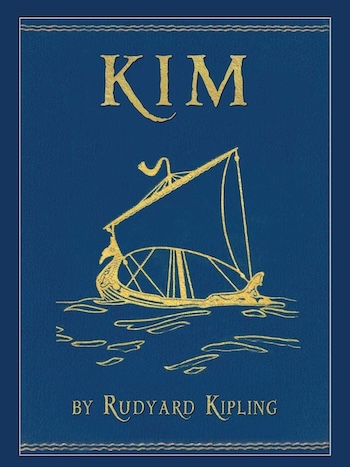 Kim by Rudyard Kipling, published in 1901, is usually regarded as the first spy novel even though it as much a story about a young boy growing up and, even more so, a lyrical homage to the beauty of India, its land and people, that Kipling so loved. Kim is a military orphan caught between two worlds, the world of the regiment and its British culture and the very different world of India outside the gates of the military cantonment. He speaks the local dialect better than English, can pass as a local and his mentor is a Tibetan lama.
After time in a Church school near the cantonment, he is recruited to act as a spy and sets off with his lama on a journey through the north-west frontier. For the lama it is a pilgrimage, for Kim it is a mission. It is the India of the Great Game between Russia and Great Britain and Kim’s task is to gather information about Russian plans. The journeys that follow are full of incident and descriptions that bring to life the landscape and people of India. Kipling may be unfashionable today, but this book is no imperial apologia. It has been filmed three times most recently for television in 1984.
Erskine Childers: The Riddle of the Sands, A Record of Secret Service
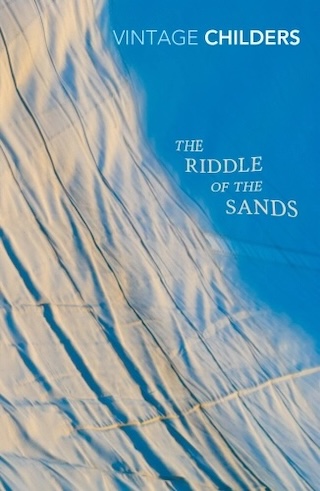 A more conventional starting point for the development of the genre is The Riddle of the Sands written by Erskine Childers and first published in 1903 with the appropriate subtitle A Record of Secret Service. Childers story is set in the Frisian Islands, the archipelago that parallels the North Sea Coast of Holland, Germany and Denmark. Two English sailors on a yachting holiday become amateur spies when, by accident, they discover the initial preparations of a German invasion plan.
A game of cat and mouse follows set on the challenging tidal waters of the German part of the Frisian archipelago as the two Englishmen try to outwit the German authorities and a shady businessman, who turns out to be even shadier than he appears. Childers was a sailor and knew the region well so his descriptions of the islands are spot on. The book was deservedly a best seller and sparked a fashion for invasion scare stories. Frequently broadcast on radio it was eventually turned into a film in 1979.
Joseph Conrad: The Secret Agent
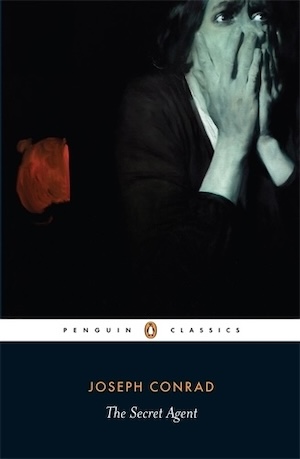 A very different spy story is The Secret Agent, written by Joseph Conrad, the great Anglo-Polish novelist, and first published in 1907. It is a story of domestic terrorism in a Dickensian setting in 1880s Soho, influenced by the anarchist violence of late 19th Century Europe. Conrad’s agent is in the employ of an unidentified foreign power, tasked to monitor the activities of revolutionary groups in London.
He is then ordered to run a false flag terrorist bomb incident to persuade the British government to take firmer action against the revolutionary groups. Conrad’s agent is no James Bond – neither a hero nor a very effective agent – and his flawed characters struggle to get by in the face of an arbitrary and heartless world. Rightly regarded as one of his finest novels it has frequently been adapted for film, television and radio, most recently as a BBC mini-series in 2016.
John Buchan: Greenmantle
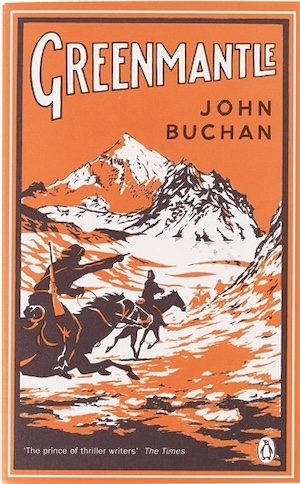 The First World War saw the emergence of the secret agent as the heroic gentleman amateur. First into the field was John Buchan with his most well-known novel The Thirty-Nine Steps, published in 1915, that has since been transferred to stage and screen, most memorably by Alfred Hitchcock in 1935. Less well-known but, in my view, a better book, is its successor Greenmantle published in 1916.
Its more realistic plot is set during the First World War and fizzes with same energy as its predecessor. Richard Hannay, the accidental hero of The Thirty-Nine Steps, is now a seasoned operator, and engaged in trying to keep the Turks from siding with the Germans, with the dénouement of the plot set in the shadows of the actual Russian defeat of the Turks at the battle of Erzurum.
Somerset Maugham: Ashenden (main image)
Although the ‘Boys Own’ style popularised by Buchan remained hugely in demand, the post-war world of the 1920s starts to see the emergence of less heroic, more complex and nuanced characters with the publication of Ashenden by Somerset Maugham in 1927. Ashenden is a collection of short stories based on Maugham’s experiences working for MI6 in Switzerland and Russia during the First World War. Ashenden, unlike Hannay, is no gentleman amateur, but a cynical realist; his character reflecting the harsh realities of espionage Maugham encountered working for MI6. Skilfully written, with interesting characters and plots, it not only influenced many of Maugham’s successors but provided a wealth of source material for film, television and radio.
Eric Ambler: Epitaph for a Spy
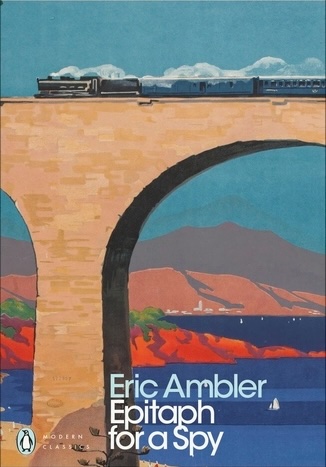 Eric Ambler did not have any personal experience of the world of spying. Prior to becoming a novelist, he was a copywriter in an advertising agency though this did not prevent him from writing a series of spy novels whose style was as influential as the short stories written by Somerset Maugham. Amongst his most influential novels, is Epitaph for a Spy, written in 1938.
The central character is a stateless Hungarian refugee with an uncertain future, temporarily resident in a hotel in the south of France. He becomes involved in a spy hunt after he has to prove his innocence when film containing pictures of nearby naval defences is mistakenly believed to have come from his camera. The atmosphere of uncertainty surrounding him never quite disappears even after the real spy is unmasked. Unease and uncertainty are frequently present in Ambler’s novels.
Graham Greene: The Quiet American
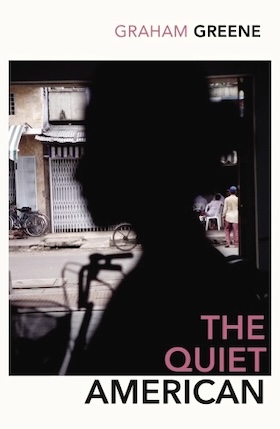 Graham Greene was, like Somerset Maugham before him, an alumnus of MI6, in his case serving during the Second World War, mostly in Sierra Leone. Also, like Somerset Maugham, whom he greatly admired, he did as much, if not more, to establish the literary credibility of novels about secret agents. His best and most influential book about espionage is The Quiet American, published in 1955 and filmed twice, most recently in 2002. It is a superb book set in Vietnam during the Vietnamese war against their French colonial masters.
The three principal characters are a knowledgeable but cynical English journalist, his much younger Vietnamese lover who is in search of security and a young idealistic and inexperienced American CIA agent, the ‘quiet American’ of the title. There are two main themes in the book: the competition between the two men for the Vietnamese girl; and the conflict of attitudes – cynical realism versus naïve idealism – towards the war and the future of Vietnam. Given when the book was written it is extraordinary how well it presages the intellectual morass over policy and politics that plagued America’s subsequent involvement in Vietnam
Graham and Hugh Greene: The Spy’s Bedside Book
I am only too aware of the limitations of this list as it ignores many worthy authors. So, for anyone just wanting to put their toe gently in the waters of the early literature of espionage I heartily recommend The Spy’s Bedside Book. It is a wonderfully eclectic, wide-ranging and entertaining anthology, that ranges from Coleridge to Colette and from Kipling to Fleming, put together by Graham Greene and his brother Hugh in 1957.
All the books listed are available under the imprint of Penguin Books and can be found at www.penguin.co.uk.