Litigious, self-mythologising and never knowingly underdressed, James Abbott McNeill Whistler cuts a singular figure among the Victorian greats. Rosalind Ormiston visits Tate Britain’s blockbuster retrospective — and the film that accompanies it…
Tate Britain’s hugely successful exhibition James McNeill Whistler introduces a twenty-first-century audience to a mid-nineteenth-century American dandy of an artist. Multi-talented, full of swagger, confidence and wit, and quick to sue for any offence, Whistler was a fabulous portraitist and landscape painter. This retrospective of around 160 paintings, etchings, sketches and drawings reveals the full range of his talent across a life and career that never settled for the conventional.
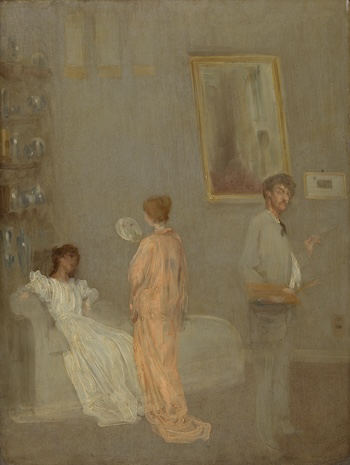
James McNeill Whistler, The Artist in His Studio. 1865-66. Art Institute of Chicago
Whistler was born in Lowell, Massachusetts, to a civil engineer father, George Washington Whistler, and Anna Matilda McNeill. He spent his early years in St Petersburg from 1843, where his father was employed to design the first major railway between Moscow and St Petersburg. Encouraged by his parents, Whistler began to practise drawing and learn languages, and spent time in England too, with his adult half-sister from his father’s first marriage. At fifteen, this way of life ended abruptly when his father died suddenly, possibly of cholera.
The family returned to the United States, settling in Pomfret, Connecticut, and in 1851, aged seventeen, Whistler attended the United States Military Academy at West Point, as his father had. Beyond his drawing classes, though, little was achieved, and he was dismissed three years later. From that point he concentrated on an art career. Support from his step-family gave him the freedom to move to Paris, to study at the École Impériale et Spéciale de Dessin and, more significantly, at the studio of the contemporary painter Charles Gleyre, where Monet, Renoir and Frédéric Bazille also trained.
The exhibition brings together the focal points of Whistler’s life, particularly his years in England from 1859 onward. He was an aesthete: his furniture and pieces from his collection of blue and white Japanese porcelain, both on show, speak to the influence of Japanese art on late-nineteenth-century Europe. He was sociable and a good host too, his house filled with friends, dealers and buyers for invitation-only “American pancake breakfasts” that more usually started at one in the afternoon.
His friends, girlfriends and wife feature throughout his paintings, alongside portraits commissioned by patrons. An early work, At the Piano (1858-59), showing a woman seated at a piano with a young girl standing and listening, won him his first major patron: the wealthy shipping magnate Alexander Ionides, who went on to commission portraits of his family. Whistler was now moving within a circle of influential, moneyed clients.
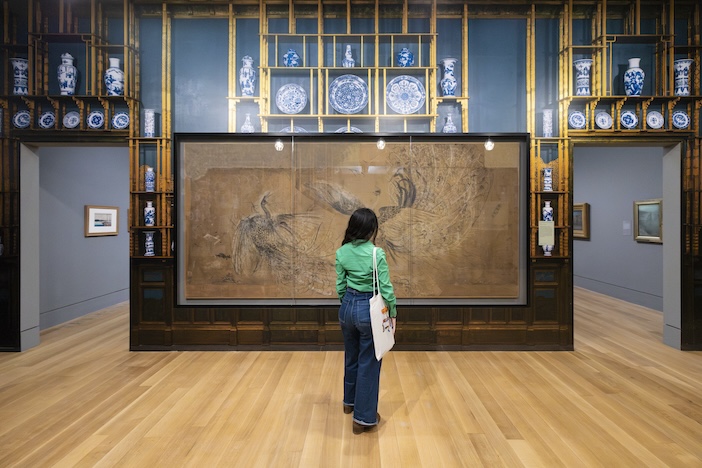
James McNeill Whistler at Tate Britain, ‘The Peacock Room’ (Photo © Tate, Larina Fernandes)
The show excels at capturing the essence of who Whistler was — nowhere more so than in his handling of the Liverpool ship owner Frederick R. Leyland’s Kensington dining room. Whistler was commissioned to make minor adjustments; instead he redesigned the room entirely, ignoring Leyland’s instructions to create his own vision — now known as “The Peacock Room” — and inviting friends to see it before Leyland himself had. It ended badly: Leyland paid only half the fee, and in pounds rather than guineas, a pointed reminder that Whistler was, in his eyes, no more than a tradesman. The Peacock Room has been recreated as a walk-in installation at Tate, giving a vivid sense of Whistler’s talent as both artist and designer.
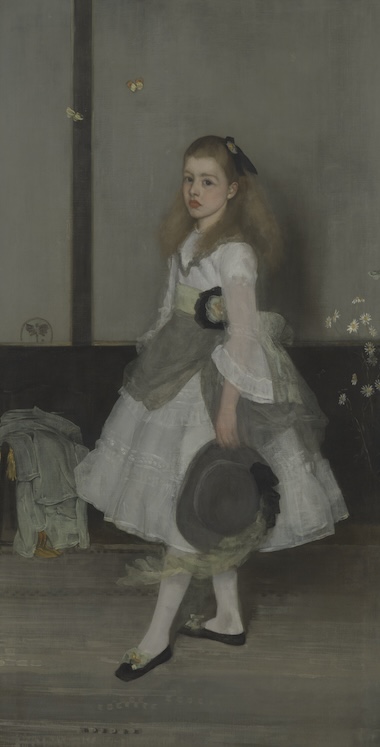
Harmony in Grey and Green Miss Cicely Alexander, 1872-3 (Tate).
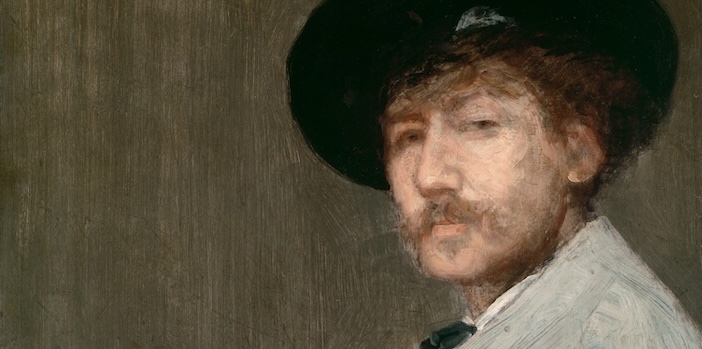
Other standout pieces include his early character studies, such as Head of an Old Man (1859) and La Mère Gérard (c.1858-59), and Wapping (1860-64), a star work that took him four years to complete, showing three friends seated on the balcony of a Rotherhithe pub overlooking the Thames. It is remarkable. Elsewhere, his self-portraits — following in the footsteps of Rembrandt — track him at different ages. Arrangement in Grey: Portrait of the Painter (1872), painted when he was thirty-four, is superb, and surely owes something to Rembrandt’s 1642 self-portrait. Whistler painted a similar composition of his younger brother William in Portrait of Dr William McNeill Whistler (1871-73).
Whistler was also notorious for the sheer number of sittings he demanded of his subjects — reportedly as many as ninety for one patron. In Harmony in Grey and Green: Miss Cicely Alexander (1872-74), the young girl was made to stand for lengthy sessions that left her in tears; her strained, unhappy expression in the finished portrait is testament to it.
The exhibition also draws on Whistler’s “nocturne” series — he titled many works after musical terms: nocturnes, compositions, harmonies, variations. In 1878, a successful career stalled when the critic John Ruskin objected to the content of Nocturne in Black and Gold: The Falling Rocket, a 200-guinea painting, writing that it was like flinging a pot of paint in the public’s face. Whistler sued for libel and won, but was awarded just a farthing in damages and left to pay the costs, which bankrupted him. His Chelsea home had to be sold, and Whistler left England for Venice, homeless, to try to rebuild his career on the strength of a small print commission.
Coinciding with the exhibition, an excellent film, James McNeill Whistler — written and directed by David Bickerstaff and Phil Grabsky, and produced by Seventh Art Productions for the Exhibition on Screen series — is in cinemas nationwide from 15 September 2026. In it, Tate curator Carole Jacobi and a number of art historians explore Whistler’s life through the works on display, offering a focused view of his world of artist-friends, models, patrons and enemies, and the who’s-who behind his portraits. Visits to the Frick Collection in New York and the Smithsonian in Washington DC — both currently lending works to Tate — bring further expert insight into why and how Whistler painted them.

James McNeill Whistler Arrangement in Grey and Black No.1 1871 Musée d’Orsay, Paris, France
The film also features the famous “Whistler’s Mother,” and art critic Rachel Campbell-Johnston recounts how the sixty-six-year-old Mrs Whistler came to model for it only because Whistler’s booked sitter failed to show. Its official title — which nods to the painting’s abstract background — is Arrangement in Grey and Black: Portrait of the Painter’s Mother, No. 1 (1871). Whistler struggled to capture the effect of light on ageing skin, scraping away and rubbing in thinned paint until he achieved his mother’s delicate, near-translucent complexion. He succeeded: it is a masterpiece. Exhibition on Screen’s film is a superb companion to the show at Tate Britain.
James McNeill Whistler runs until 27th September at Tate Britain, Millbank, London SW1P 4RG. For more information, and for tickets, please visit www.tate.org.uk.
The film ‘James McNeill Whistler’ is released by Exhibition on Screen on 15th September 2026. For more information, and to find out where it’s screening, please visit www.seventh-art.com.
Header image: Detail from Arrangement in Grey Portrait of the Painter, 1872 (Detroit Institute of Arts).