With the weather turning, the Royal Academy offers the next best thing to a trip south — a century of artists chasing the light along the Côte d’Azur. Art writer Rosalind Ormiston reviews…
As autumn sets in, a visit to the French Riviera would be rather nice. In London right now, at the Royal Academy of Arts in Piccadilly, the major exhibition Painting the French Riviera takes visitors on an adventure around the Mediterranean through 120 paintings, sculptures, travel posters, film and books, crystallising exactly why we love the Côte d’Azur.
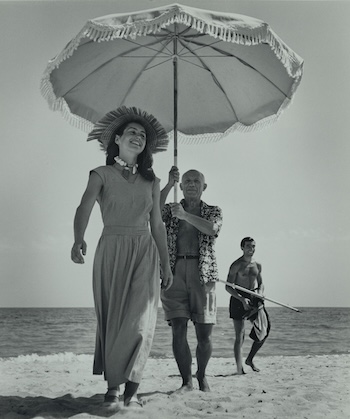
Robert Capa, Pablo Picasso and Francoise Gilot at Golfe Juan, August 1948 (Yale University Art Gallery)
In the company of artists from the Impressionists painting on the Riviera in the 1870s through to Yves Klein in the 1960s, the pleasure of being on the coast is revealed through nearly a century of stunning works by artists “chasing the light” and promoting its beauty through their art.
The term ‘Côte d’Azur’ was first coined by the French writer, poet and lawyer Stephen Liégeard, who had a house in Cannes, to describe the scenic blue skies and sun-drenched coastline edging the Mediterranean. Liégeard was not alone in recognising the beauty of the French Riviera: artists Paul Cézanne, Claude Monet, Pierre-Auguste Renoir and Berthe Morisot loved it too, among many others, and their art established the Riviera as a landscape of extraordinary colour and light. The RA show opens with some of their work in its first gallery, “Cézanne and the Impressionists”.
Cézanne described the French Riviera as being “like a playing card. Red roofs against the blue sea”. From the 1860s he stayed in L’Estaque, a fishing village on the north-western edge of Marseilles, its backdrop of mountains appearing in geometric form throughout his paintings. His presence drew other artists to visit and paint. Both Monet and Renoir spent time with him there, and it was in L’Estaque that Cézanne began his series of “bather” paintings, as in Bathers (1890-92).

Paul Cézanne, Bathers, 1890-92. (Saint Louis Art Museum)
By coincidence, Renoir, visiting in 1882 and painting alongside Cézanne, shifted his own compositions away from social gatherings toward classical nudes, including nude bathers. This first room shows the diversity of the period’s art, including wonderful landscapes by Berthe Morisot, who visited Nice with her family in 1881-82 and again in 1888-89 — a fitting opening to the breadth this show goes on to explore.
Monet, the original Impressionist, first visited in January 1884 and returned regularly, staying in Bordighera, Cap Martin and Antibes. His works capture the landscape and sea; he described the thrill of being on the Côte d’Azur as “so beautiful here, so bright, so luminous. One swims in blue air”. That sense of wonder translates directly into paintings such as Morning at Antibes (1888). Henri Matisse put his own reaction into words too, “The sea is blue, but bluer than anyone has ever painted it, a colour entirely fantastic and incredible”.

Henri-Edmond Cross, Les Îles d’or, îles d’Hyères (Var), c.1891-1892. (Paris, Musée d’Orsay)
At the RA, look out for the pointillist technique of the Neo-Impressionists, particularly Paul Signac’s Le Pin de Bertaud (1900), and the shimmering heat of an azure sea in Henri-Edmond Cross’s Les Îles d’Or, Îles d’Hyères (Var) (c.1891-92). Both epitomise what the exhibition sets out to explore. Some gallery sections concentrate on individual bodies of work — Pablo Picasso and Henri Matisse each have their own space, and a whole gallery is devoted to Pierre Bonnard’s Mediterranean paintings, created between 1904 and 1947. ‘The Fauves’, primarily Matisse and André Derain, painted in Collioure on the Mediterranean coast between 1905 and 1908, producing radical, wildly colourful compositions that went on to influence art across Europe.
The changing colours and hues of light that drew painters to the Riviera are visualised in the RA’s own gallery spaces too, the walls filtering from deep blue through cerulean and turquoise to a pale white, building toward the ultramarine of Yves Klein’s sculpture and paintings — among them the vast ANT 64 (1960), created in his copyrighted paint formula, International Klein Blue (IKB).
Painting the French Riviera is on now (until 31st January 2027) at The Royal Academy of Arts, Piccadilly, W1J 0BD. For more information, and for bookings, please visit www.royalacademy.org.uk.
Rosalind’s new book, ‘Masters of Art: Monet’, is available now from Prestel Publishing, 2026.
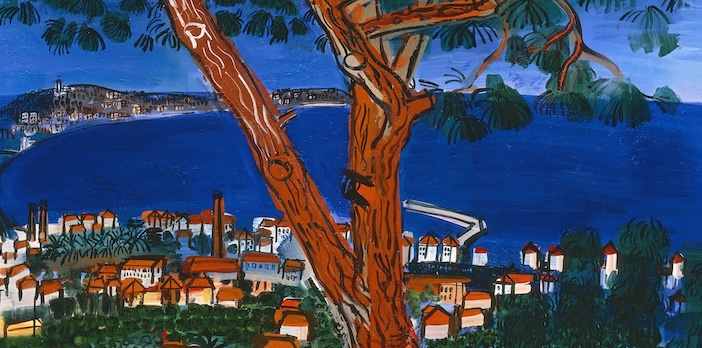
Header image: detail from Golfe Juan (1927) by Raoul Dufy