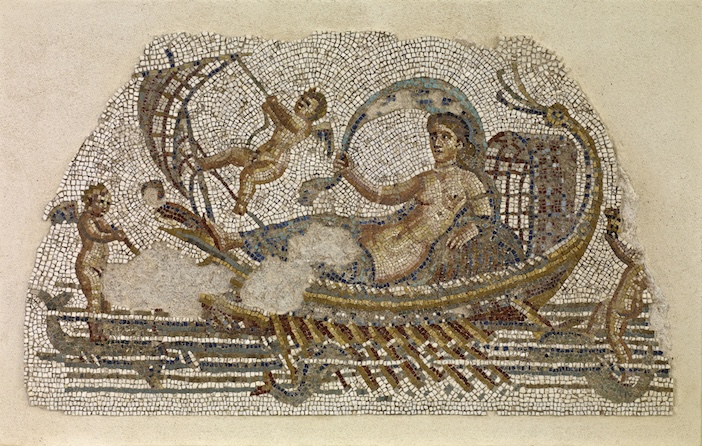
At the Ashmolean in Oxford, a new exhibition traces Aphrodite back to her Cypriot roots as protector of seafarers and the copper trade, and forward to more contemporary icons. Rosalind Ormiston reviews…
At the Ashmolean Museum in Oxford, the new exhibition Aphrodite: The Making of a Goddess explores the origins of Aphrodite (that’s Venus, to fans of Roman history) and her adaptation through the centuries, from 3,000 BCE to the present day. In Classical Greece and Rome (roughly 5th century BCE to 5th century CE) and throughout the modern era, she has been framed as the goddess of love, sex and beauty. Yet her origins lie in Cyprus, where she was worshipped more than 3,000 years ago as a protector of seafarers and trade, particularly copper mining. With more than 150 objects spanning 5,000 years, the show defines those origins and shows how the goddess has influenced succeeding generations, finding her presence in archaeology, art, sculpture, literature, music and fashion.
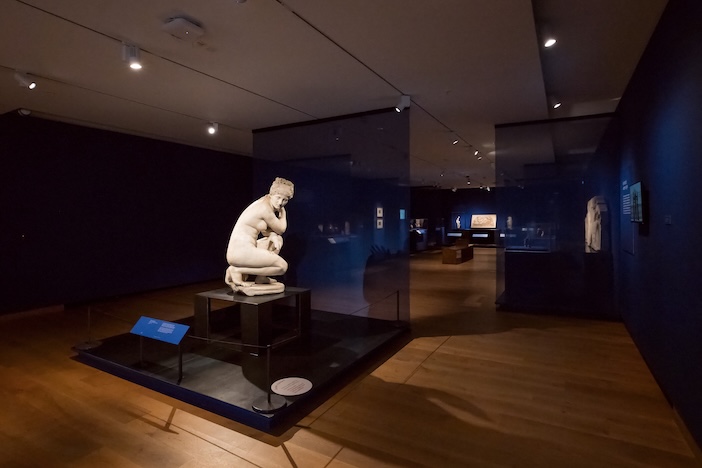
Installation photo by Hannah Pye
Curated by Dr Anja Ulbrich, A.G. Leventis Curator of Cypriot Antiquities at the museum, the exhibition has some outstanding examples of Aphrodite, on loan from major galleries around the world. It opens with the life-size marble nude Crouching Venus (late 2nd century CE), a Roman variation of a Greek original created by the sculptor Doidalsas around 200 BCE. Found in Italy, it later served as a model for Renaissance artists and sculptors as the goddess travelled through time.
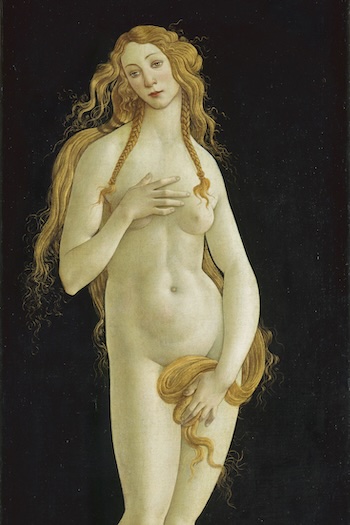
Detail from Sandro Botticelli (and workshop), Venus, c. 1490 (Staatliche Museen zu Berlin, Gemäldegalerie. Photo: Jörg P. Anders)
Botticelli’s well-known The Birth of Venus (c.1485) depicts her standing on a shell rising from the sea, symbolising her birth from the foam that gathered around the severed genitals of her father Uranus, thrown into the sea by his son Cronus. The goddess is said to have emerged from the sea foam near Cyprus — indeed, her name derives from aphrós, meaning ‘sea foam’, providing much fodder for the poets of ancient Greece, including Hesiod.
In Cyprus, a single, all-powerful deity known simply as ‘the goddess’ was worshipped by Cypriots for over a millennium. Homer and Hesiod both called her by a Cypriot name, Kypria (‘the Cypriot Goddess’). She was a protector of the natural world and of fertility, held political and military power, and was worshipped as the goddess of seafaring and trade, the core of Cypriot wealth. Immigrants and visitors to Cyprus learnt about the deity, and her worship spread across the Mediterranean.
Less well known is her connection to the copper trade. Copper was mined in the Troodos mountains, formed into standard-weight ingots and shipped across the Mediterranean to be sold or traded; alloyed with tin, it made tools and weapons. The symbolism is best captured in a tiny copper-alloy figurine of the naked Cypriot goddess standing on an oxhide ingot-shaped base, made around 1200–1100 BCE.
The ancient section shows Aphrodite in many forms and materials, from small figurines to vast freestanding sculptures in marble and precious metals, and depicted on coins and vases, where she is also referred to as Astarte. Her beauty is confirmed in bronze and marble figures of the goddess holding a mirror to her face, a symbol of beautification.
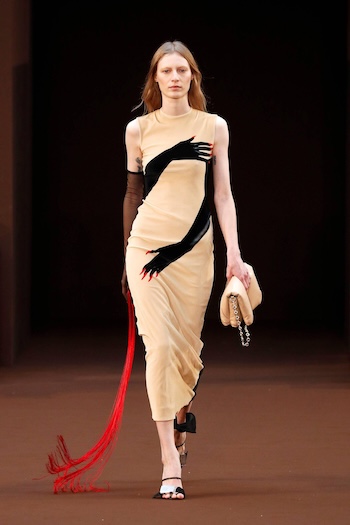
Gloves print dress, LOEWE Fall Winter women’s runway collection, 2022. Designed by Jonathan Anderson.
A fine example of the Roman tradition is the Capitoline Venus (160 CE), a copy of a statue of Aphrodite by the Athenian sculptor Praxiteles in the mid-fourth century BCE. Praxiteles radically changed the perception of the goddess by depicting her bathing, completely undressed, and it is from this nude statue that the sexual interpretation of Aphrodite developed. The presentation then travels through the centuries to the Renaissance ideal of beauty, when humanism gripped Florence and Rome in the quattrocento, renewing interest in the Classical era and its gods and goddesses. Aphrodite became a representation of the ideal woman.
The dynamic is heightened when the focus turns to popular culture. The twentieth century brings Man Ray’s Venus Restored (1936), Michelangelo Pistoletto’s installation Venus of the Rags (1967) and Yves Klein’s Blue Venus (1962), in his signature International Klein Blue (IKB), a matte ultramarine pigment. The all-female British pop group Bananarama are here, too, exemplified by their song ‘Venus’.
And not to be missed is the American superstar Beyoncé, redefining the goddess in fashion and film for the twenty-first century. A ‘Venus Pudica’ (modest Venus) hand-motif dress created by Loewe in 2022, on show and on film in the exhibition, was worn by Beyoncé on stage, shifting the vision from a crouching naked goddess to an emancipated Black woman.
From goddess of copper mining to global superstar, Aphrodite redefines her image for every generation, and the Ashmolean shows us how.
Aphrodite: The Making of a Goddess runs until 11 April 2027 at the Ashmolean Museum, Oxford (Beaumont Street, Oxford OX1 2PH). For more information, please visit www.ashmolean.org.
Header image: Detail from Aphrodite on a barge sailing the sea Utica, Tunisia, 250–200 CE Mosaic (Photo: © Musée du Louvre)