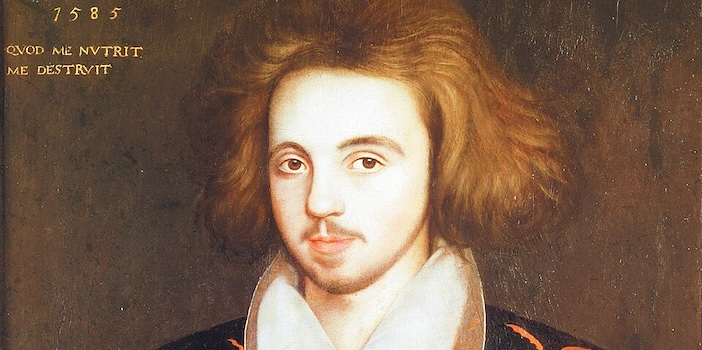
A duel scar, a government cipher and a knife in a Deptford tavern – in his new book Stephen Greenblatt tracks the short, incendiary life of the playwright who taught Shakespeare how to write for the stage. Philip Cottam is gripped…
On the 30th May 1593, the wild and reckless young man that was Christopher Marlowe, heretical hedonist and government spy, yet whose extraordinary genius as poet and playwright lit the fire that became the English Renaissance, died at the age of 29, in a brawl in a Deptford hostelry. Like so much of his largely undocumented life the reasons behind the brawl remain the subject of much supposition. Was it an argument over the bill, a falling out amongst friends or a targeted assassination? Arguments when men carried weapons sometimes had violent outcomes. Marlowe himself was imprisoned briefly in 1589 as an accessory to murder following a brawl.
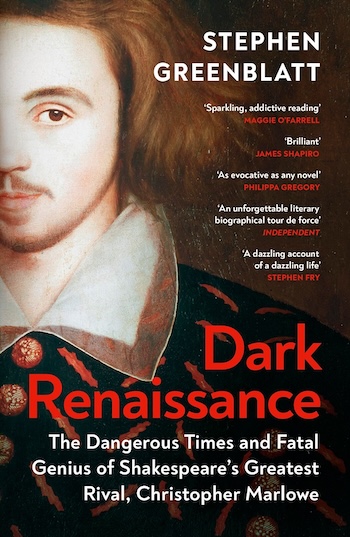 What is without question is Marlowe’s literary genius and his impact on the English language. Stephen Greenblatt, a doyen amongst scholars studying renaissance England, published a wonderful biography of Marlowe last year, Dark Renaissance: The Dangerous Times and Fatal Genius of Shakespeare’s Greatest Rival, now out in paperback. His book provides a measured examination of Marlowe’s turbulent short life, a clear explanation of his literary genius and a colourful picture of the exciting but often dark and frequently dangerous world of Elizabethan England that Marlowe inhabited.
Elizabethan England was a dangerous place, riven by plague, vagrancy and the bitter religious and political divisions left by the Reformation, in which heresy was punishable by burning and sheltering a Catholic priest could be treason. One of the results was a dangerous game of spy and counterspy involving all sorts of dubious characters. It comes as no surprise that the risk-taking Marlowe allowed himself to be recruited while studying for his Masters degree at Cambridge, becoming another pawn in the complex web that Sir Francis Walsingham, spymaster in chief for the Queen, was weaving from a modest bolthole in Seething Lane not far from the Tower of London.
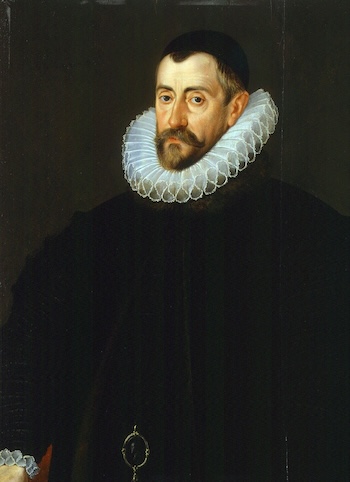
Sir Francis Walsingham by John De Critz the Elder (National Portrait Gallery)
Marlowe was clearly used as an agent in the field as he was frequently absent from his studies and was only granted his degree because of a letter sent to the university by the Queen’s Privy Council commending him for his services. Greenblatt certainly brings this part of Marlowe’s story to life. It all seems very modern with agents recruited from the universities, the cast of characters a mixture of defectors, double agents and fraudsters and the line between treachery and loyalty often becoming blurred.
Central to the story that Greenblatt tells is his explanation of how in six short years Marlowe changed the way people wrote for the stage despite his plays only being published with his name attached the year after his death. In doing so Greenblatt unpicks the themes of the plays as well as illustrating how Marlowe used the stories he was telling to challenge the social, religious and political orthodoxies of the day. This was a dangerous game, which at a time of religious division and political turmoil, could lead to torture and execution and may possibly have played a part in Marlowe’s demise. As Greenblatt suggests it was the excitement of his plots and the clever eloquence of his language that kept Marlowe safe, at least until that fateful day in Deptford.
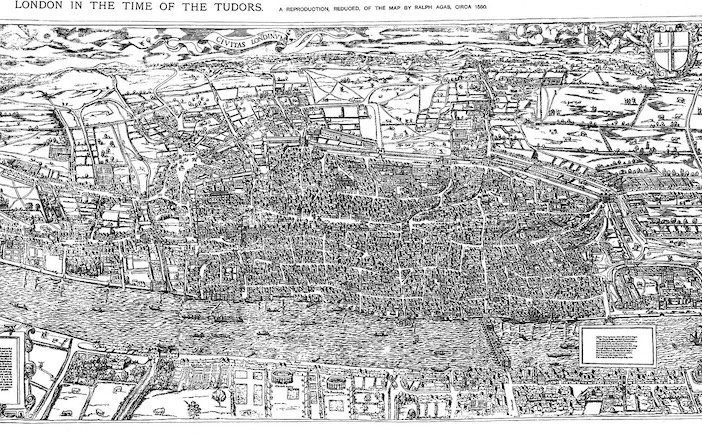
Civitas Londinium, Agas’ Map of London, c. 1570-1605
In Tamburlaine the Great, for example, Marlowe celebrates the over-turning of established orders with the rise to power of an Uzbek peasant. In The Jew of Malta, one of the inspirations for Shakespeare’s Merchant of Venice, Marlowe not only has a homicidal Jewish anti-hero but also a character based on Machiavelli through whose voice he expresses his politically heretical thoughts, describing religion as the ‘everlasting superstition’. In Dr Faustus, his greatest and most well-known play, he created, in Greenblatt’s view, ‘a tragic hero unprecedented in all of English drama’ – a man so determined to escape the moral constraints of conventional religion that he made a pact with the devil, only to discover hell was in the here and now.
The extraordinary public success of his plays added to Marlowe’s notoriety but also enabled him to secure the patronage of free-thinking courtiers such as Walter Raleigh and Henry Percy. However, their patronage was not enough to keep him safe, although it was not his plays that resulted in his arrest on the 18th May 1593. It was almost certainly the suspicion of his possible authorship of a heretical and incendiary flyer pinned to a church door signed Tamburlaine. A fellow playwright, Thomas Kyd, had already been tortured during the search for the culprit, and referred afterwards to what he described as Marlowe’s ‘monstruous opinions’. It was only weeks after Kyd’s release that Marlowe was killed with no charges raised against his killer – hence the possibility of an assassination.
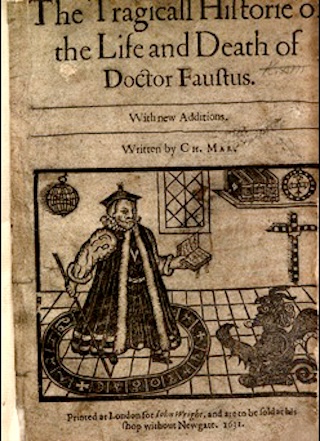
Marlowe’s Doctor Faustus frontispiece (1631)
One of the joys of Greenblatt’s explanations of the magic that Marlowe wove is that he avoids jargon and does not set out to impose some artificial literary theory on the texts. He lets Marlowe’s language speak for itself and places its meaning in the context of the time. It was Marlowe who made blank verse the principal form used by the playwrights of the English Renaissance when, at the age of 23, he produced his second play Tamburlaine the Great; for Greenblatt its impact was as dramatic as that of the talkies on cinema. Of perhaps even greater importance was Marlowe’s invention of the soliloquy, first significant appearance on stage in perhaps his greatest play – Dr Faustus – first performed the year after his death. It has had a permanent impact on English theatre far beyond the theatre of the English Renaissance.
Marlowe had begun life as one of the nine children of a shoemaker in Canterbury and had secured a scholarship to the King’s School that provided the launching pad for what followed. Short his life may have been, but it was certainly eventful and has clearly left an indelible mark on the English imagination. Greenblatt is clear that without Marlowe’s introduction of the soliloquy and the iambic pentameter, Shakespeare, who was also born in 1564, would not have become the commanding cultural icon we know today. Of Shakespeare’s thirty-eight plays over thirty were written after the first performance of Marlowe’s Dr Faustus. Greenblatt has produced an immensely readable book that is not only a fascinating biography but also an illuminating introduction to a turbulent world in the midst of a culture war as England escaped the weakening bonds of medievalism for the new freedoms of the Renaissance.
Dark Renaissance: The Dangerous Times and Fatal Genius of Shakespeare’s Greatest Rival is available now in paperback, priced £12.99, published by Vintage. For more information, please visit www.penguin.co.uk.
Images courtesy of Wikimedia Commons