With the Meltemi blowing and the fishing boats in harbour, Teresa Levonian Cole goes ashore on Syros to learn its Venetian, Ottoman and merchant past, before a private chef at Villa delle Grazie finds her the fish of the day…
‘On a day like this?’ The waiter at the waterside taverna almost laughed in my face when I asked about the fish of the day. ‘What fisherman would go out in weather like this?’ His response illustrated two truths: first, that in Greece, ‘fish of the day’ is exactly that; none of your ‘caught three months ago and just arrived from Japan’ malarky. And second, that the seas were far from calm.
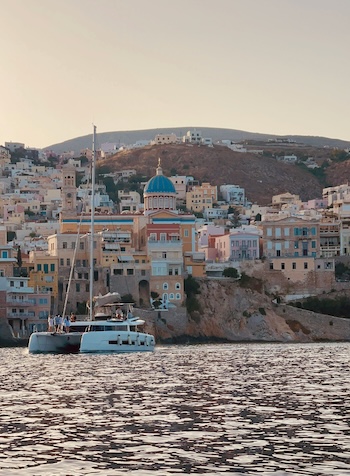
photo by Stratigo Douka (courtesy of Unsplash)
Despite the glorious October sunshine, Boreas was in full flow, whipping up a force 8 northerly wind that saw our jet boat from Athens cancelled the previous day. For visitors to the Cyclades, the Meltemi, as this wind is known, is a familiar menace to the best laid plans of mice and men.
I was in Syros, a stately, elegant island in the Cyclades whose capital, Ermoupolis, famed for her grand neoclassical buildings, differs so markedly from the picturesque white and blue dwellings of her sister islands. Syros, moreover, the cultural heart and administrative centre of the Cyclades, has been spared the mass tourism and accompanying hotels that mushroom on neighbouring Mykonos, Santorini and, increasingly, Paros. Instead, Ermoupolis buzzes year-round with local life – a glimpse into the Greece of old.
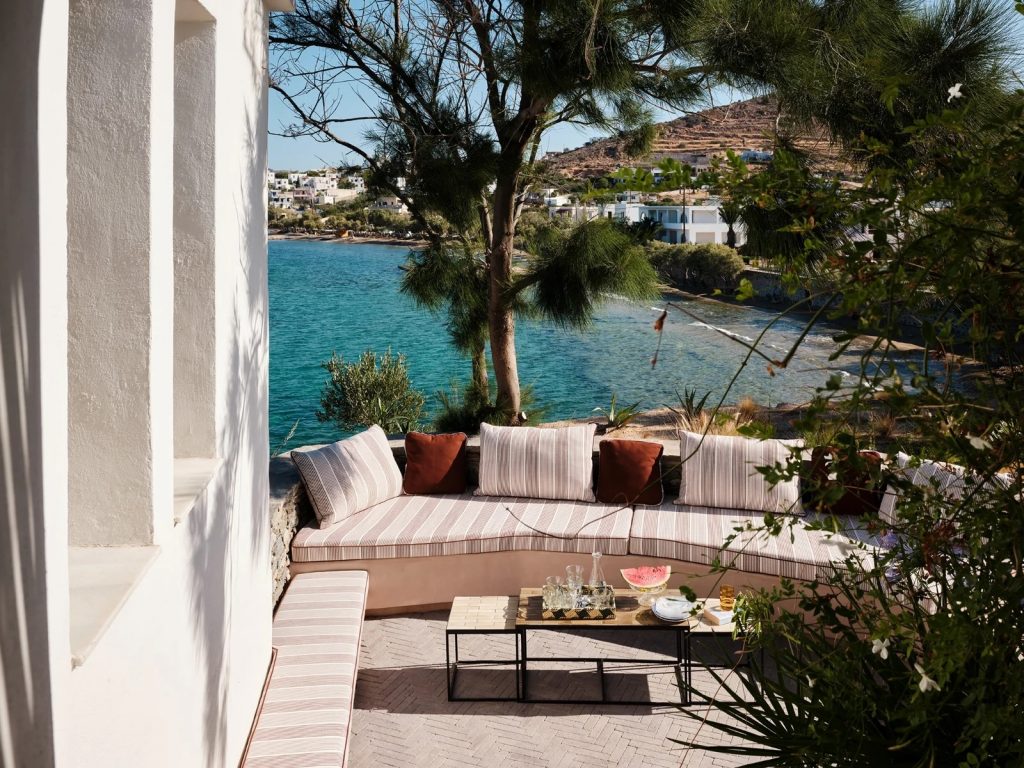
This is where the Eugenes Collection comes in – a company that specialises in luxury villas on quiet islands, or in remote spots on noisier ones, along with staff and concierge services that cater for every whim. We were staying in the Collection’s Villa delle Grazie, set on a hill immediately above the sea in Poseidonia, on the southwest coast – the villa’s rambling, seven-bedroom interior belied by its modest, whitewashed and windowless façade. Instead, the villa’s gaze is focussed on the sapphire sea through large, half-moon windows, like blinking eyes in the light, and a vast, semi-covered terrace.
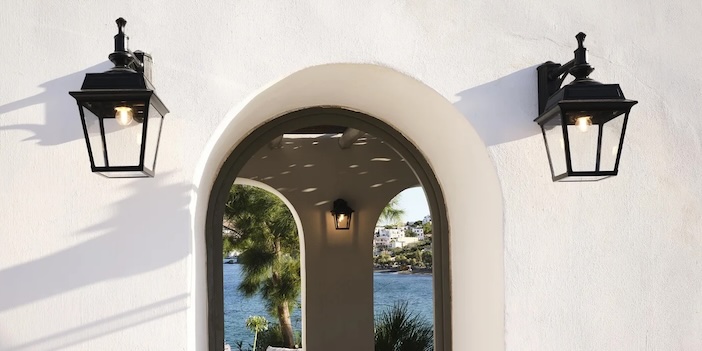
Eccentric by any definition, the villa was built for a Scottish judge in 1872, the renovated interiors a blend of European and Asian antiques, contemporary furnishings, love-me-or-hate-me modern art, and huge iron lanterns that hang above a marble dining table large enough to accommodate a community of cenobitic monks. Floors are of stone or wood; walls of whitewashed stone or plaster, the whole a beguiling interplay of rough and smooth, old and new, style and comfort.
Arriving late, to a well-stocked fridge and a midnight snack, I fell asleep to the sound of the sea crashing onto the rocks beneath my window, and woke with a start the following morning: jewel-like light revealing the previously invisible design of a wall-sized stained-glass window – a 19th-century Pre-Raphaelite-style memorial to one Henry Rutt.
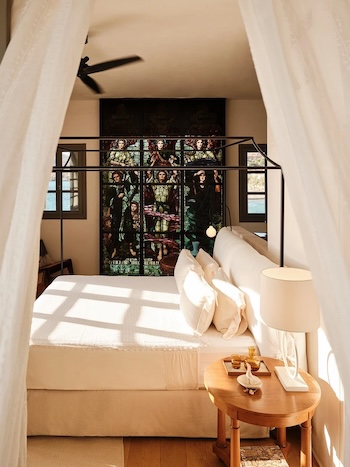 The Aegean looked deceptively inviting, wind-rippled like an ikat. But the weather, alas, did not allow for swimming from the private platform beneath the villa, the Meltemi also scuppering arrangements our concierge had made for lunch on a beach accessible only by boat. Instead, we ventured into town to learn about the island’s unique culture and history.
One of the peculiarities of Syros can be traced to the hated Fourth Crusade under Doge Enrico Dandolo, which saw the Sack of Constantinople in 1204. On their return, the Venetians captured Syros, which had been part of the Byzantine Empire, demanding that the islanders change their language and religion. The Greeks refused the former, but acceded to the latter, the Catholic church of San Giorgio, originally built by the Venetians, crowning the medieval town of Ano Syros. To this day, 47% of the population of Syros remains Catholic – an anomaly in Greece.
With Xanthe, our enthusiastic guide, we wandered down steep steps and narrow, covered alleyways, and through the maze of tightly packed whitewashed houses that tumble down the hillside to form a composite fortress decorated with geraniums and bougainvillea. Once, Ano Syros was surrounded by a seven-gated wall – protection against pirate incursions. Today, well-fed cats patrol the atmospheric alleys, keeping a watchful eye on visitors.
Despite coming under Ottoman rule in 1537, Catholicism endowed Papal and French protection on the islanders, who remained neutral during the War of Independence against the Turks. Syros thus became a haven for refugees from other islands – beginning with those from Chios, during the massacre of 1822 (famously depicted in Delacroix’s Scenes from the Massacre at Chios). With these refugees came commerce, wealth, and the founding, in an ‘uninhabited, deserted stretch of coast’, of the Orthodox town that would, in 1826, be named Ermoupolis – after Hermes, the god of trade. Her port became the most important in modern Greece, shipbuilding and infrastructure flourished, ship owners and merchants built mansions, and streets were paved in marble from Tinos, which led the poet and painter Edward Lear to dub Syros ‘the old sparkly pile’.
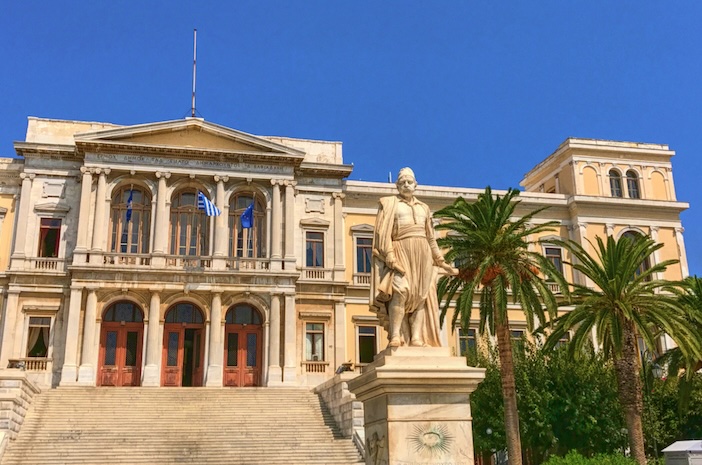
Ermoupolis (photo by Marios Kefalas, courtesy of Unsplash)
Ermoupolis’ shoreline is much like that of any island – a port, warehouses, shops and restaurants. But stroll inland a couple of hundred yards, and you find Miaouli Square on what was the original seafront, and the largest, most imposing Town Hall in all of Greece: the creation of German architect Ernst Ziller, its yellow-and-white neoclassical façade dwarfing the palm trees on the square.
The grandest of the 19th-century mansions are found leading from the square up to Vaporia, via the Orthodox church of St Nicholas. And along the way lies a wonderful surprise, indicative of the island’s former prestige: the Apollon Theatre. Designed by Pietro Sampo as a miniature amalgam of the opera houses of Milan, Naples and Florence, it opened in 1864 with a performance of Verdi’s ‘Rigoletto’, watched by the opera composers, Dante, and the playwrights of ancient Greece depicted on the dome. Sarah Bernhardt, it’s said, also once graced this theatre – not as actress, but as spectator.
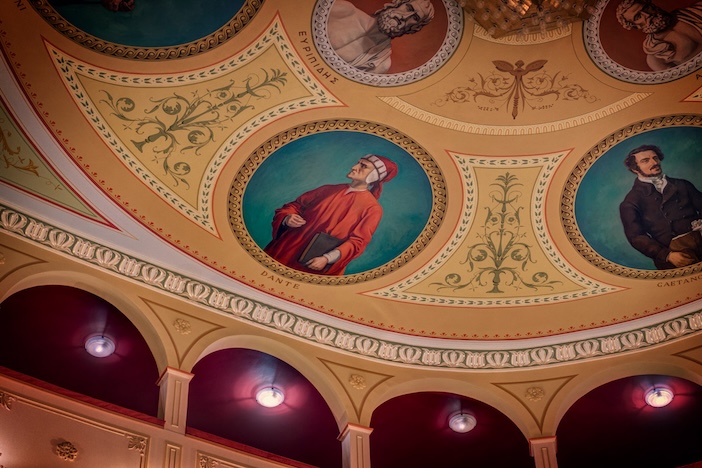
‘There are still some 1,200 neoclassical mansions on the island, with their frescoed ceilings and sweeping staircases intact,’ says Xanthe, as we stroll beneath wrought-iron balconies whose marble undersides have been carved for the delectation of pedestrians below. ‘Some still belong to the original families, but many have been turned into boutique hotels.’
Not all are in great shape, however. Some, along shopping streets, are in dire need of some TLC. We passed alleyways covered in grape trellises, lined with tables and colourful café chairs. We called in to the Church of the Dormition, to see a small El Greco – painted in the Cretan style, while he was still known as Domenikos Theotokopoulos – and only attributed to him in 1983. 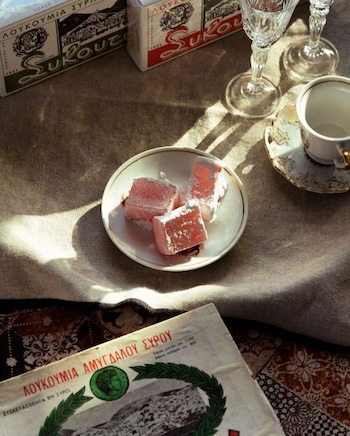 And we sampled loukoumia – another gift of Chiot refugees to Syros – at Sykoutris. This, the oldest loukoumi manufacturer on the island, still uses the 1822 recipe of its Chios ancestors, hand-making the sweets (better known in Europe as Turkish delight) in huge, heated copper cauldrons.
‘Syros loukoumi, flavoured with mastic, rose sugar or almonds from Chios, won first prize at the first world food exhibition in Paris, in 1850,’ Dina Sykoutris tells me. ‘It was the Chiot pastry chefs who taught the Ottoman Turks the technique, in the 17th century. The Turks called it lokum – sweet of sugar and cornflour – and the name stuck.’
On the subject of food – well, Syros’ culinary delights are another story to be told! Suffice to say, we had the services of Dimitris Plytas, owner of the restaurant PeriTinos, as our personal chef at the villa. That evening, he arrived to create a veritable feast, accompanied by surprisingly excellent local wines. Among the embarras de richesse were crayfish tartare with the freshest sea urchins; fava bean purée with cuttlefish; youvetsi with local San Michali cheese and king prawns; and Mediterranean parrotfish in a chickpea and tomato stew.
I couldn’t have been happier. Somehow, despite the best efforts of Boreas, Chef Dimitris had managed to procure my fish!
Villa delle Grazie, Poseidonia, Syros, sleeps up to 14 guests in seven bedrooms and is available through the Eugenes Collection. For rates, reservations and concierge services, please visit www.the-eugenes.com.
Several airlines, including British Airways, fly from London to Athens. Blue Star Ferries and Seajets sail to Syros from Piraeus, and the high-speed crossing takes about two hours.