In a distant corner of the Adriatic, once the Habsburgs’ cure for what ailed them, Larry checks into the boutique Hotel Alhambra, on an island that got there before wellness was a word…
Technically, we’re in Istria. It’s a misty drive through pine-dressed mountains, terracotta rooftops, villages in various states of restoration and repose, and glimpses down to the sea. Losinj itself is something of a schlep, from anywhere, but I’ve written many a tome in these pages about the pleasure being in the journey, and the joys of losing yourself in a distant, discoverable part of the world.
From Pula, we get our first glimpse of the destination as we round the top of the mainland, down to the ferry that carries us across to the islands. Once over the strait, it’s an hour down the length of Cres, the mountains taper into rolling heathland, through villages like Osor, from which we cross the smallest of bridges onto Losinj itself.
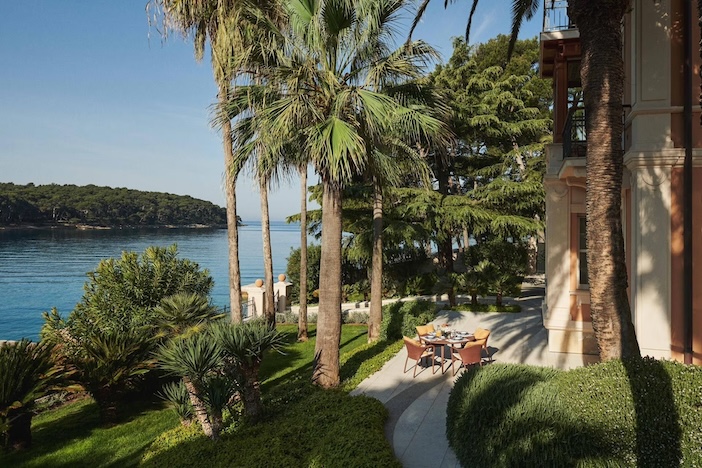
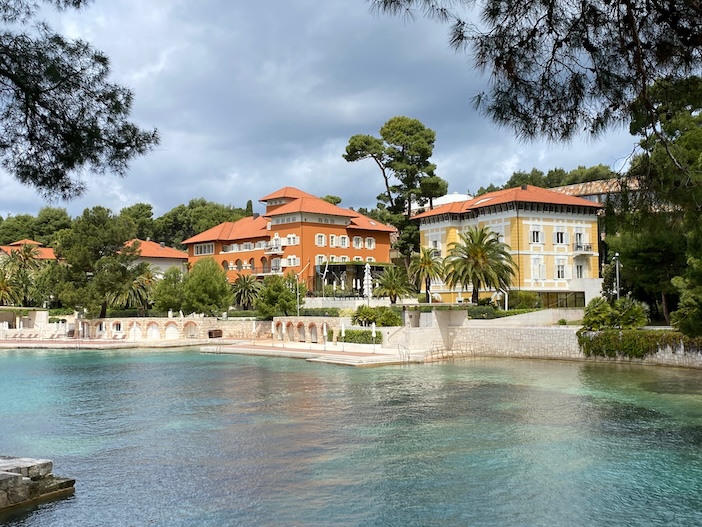
We’re headed to Čikat Bay, a small cove on the far side of a narrow isthmus shaping a long natural harbour into Mali Losinj, the island’s largest town — though that rather overstates it. Here, cradled in pine woodland at the water’s edge, sits Hotel Alhambra; three buildings, two of them former villas — the oldest dating to 1908 — bookending a more contemporary addition. It’s part of a wider estate, Losinj Hotels & Villas, arranged around the bay to take in the sleeker Bellevue and five fin-de-siècle villas besides.
With a scattering of independent cafés, eateries and activity outfits along the waterfront, it has all the benefits of a resort, just without the whiff of entrapment. Looking at this setting, I’m intrigued as to how these grand, palatial houses — now fitted out with mind-bogglingly stunning interiors — ever came to be here, in this distant, even remote corner of Croatia. The answer would come the next morning. For now, I was happy enough simply settling into this slice of idyll.
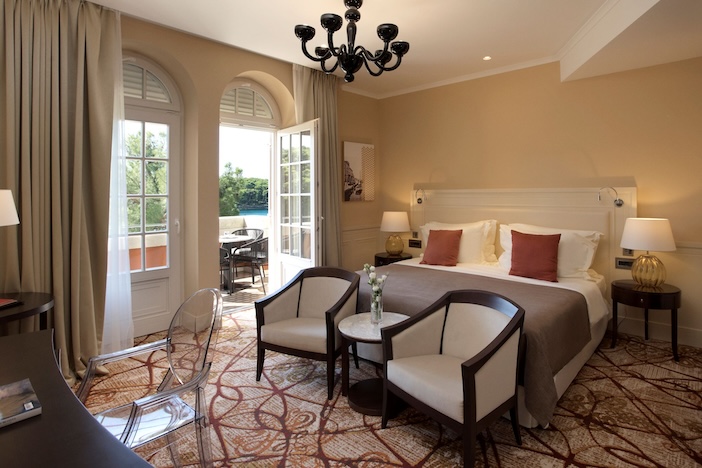
Inside, the design is contemporary and eclectic, without losing its sense of history; stylised artworks show the villas in yesteryear, butting against striking modern fixtures, captured against the backdrop of the buildings’ original features. One minute you can be looking onto the bay through wraparound floor-to-ceiling windows in the lobby, then you turn a corner and enter the wood-panelled library, enjoying petit fours, served every tea time.
My room is in one of the older buildings, so it keeps a number of original features. Perhaps the most striking touch, besides the double-height ceiling, is a bathroom that opens straight onto the terrace. There are lovely details, too; the motion sensor light in the walk-in wardrobe, the mood lighting, the TV speakers built into the bathroom mirror — useful when not wishing to miss the news while preparing for dinner.
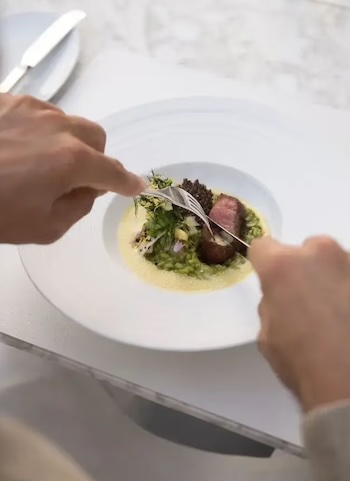 That evening, at Alfred Keller, Alhambra’s Michelin-starred restaurant, I crack the wax seal on a menu billed as three courses that amounts to nearer eight. I’m not sure why I should be surprised to find exceptional cuisine tucked into a secluded cove on this distant stretch of the Adriatic — Michelin reaches most corners of the world these days — but I was.
Snacks alongside a Slavonian barrel-aged negroni ran to a parmesan and truffle croquette, presented as a black truffle on a bed of moss, and bacon-wrapped asparagus with goat’s cheese foam. The highlight, though, was the kingfish — flambéed, the waiter told me, a technique I thought had gone out with the ’70s — in a tangy tomato consommé with pickled fennel. There are joys, too, among the wines. A sparkling Tomac, rivalling anything southeast England might produce, would become a new regular aperitif on my visit.
Being in such a pine-rich, picturesque setting rather infuses one with a desire to embrace nature. In my case, quite literally. The spa offers rituals of an arboreal bent, so, duly fortified with a hot ginger and lemon before breakfast, I’m out into the woods for a mindful ‘breathing’ session among the trees. A shoreline promenade runs not just around Čikat Bay but much of the island, and it’s here, walking through the pines with the sea lapping just feet away, that you get a real sense of place. It is, entirely, serene.
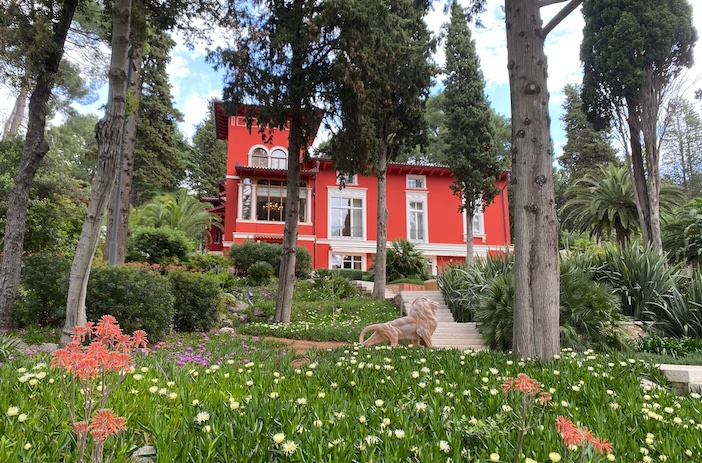
I pass jasmine and am awash with scent. The island’s restorative reputation, it turns out, is not just hokum. On this meandering walk I learn why the villas exist here at all. Under the Austro-Hungarian empire, Losinj became known as a health resort, thanks largely to the botanist Ambroz Haračić — commemorated with a statue in the bay — who catalogued the island’s flora while searching for a cure for his son’s asthma. Word spread, and soon the Habsburgs’ glitterati were building palatial holiday homes in this botanically rich corner of the empire. A handful of those properties have since become Alhambra and its villas, and staying in them, I confess to feeling ever so slightly imperious myself, lordly parading down to the seafront in my bathrobe.
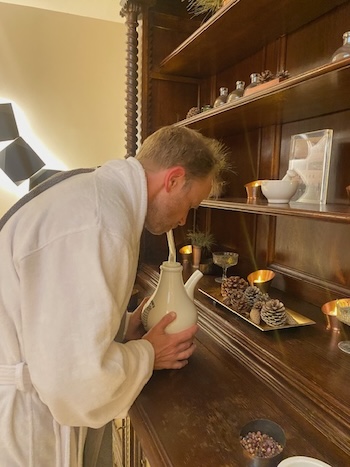 Even today, with 1,200 plant species and its agreeable climate, Losinj ranks among the most botanically wealthy islands in the Mediterranean, a legacy the hotel’s spa captures with an “inhalation bar” — its take on a respiratory tonic that dates to 1892, when aristocratic visitors would stop at the island’s Kurhaus to breathe in mists of seawater and medicinal aerosols.
Waiting for my therapist and a signature herbal massage, I find the modern equivalent: an antique cabinet housing a bulbous ceramic vessel from which one inhales plant-infused sea air. Perhaps more psychosomatic than efficacious, but between the botanical walk, the cold sea plunges from the sundecks and a lungful of resin-scented air at every turn, I was beginning to feel thoroughly, if implausibly, cured.
It wouldn’t be Croatia without getting out on the water, and this being a lesser-known region, there are some genuinely untapped spots left to find. Sailing might be the purist’s choice, but without the luxury of time, a powerboat — sun deck, naturally — is the more efficient option. We skip across to Susak, visible from Losinj, for a spot of exploratory beachcombing. It has a population today of barely 150 — a small port village, a church and a lighthouse marking its highest points — and crossing the water towards it feels rather like crossing time. Before the war, the population was closer to 1,600, ten times its current size, and the island lived on wine; when the new communist government taxed the trade into oblivion, the islanders left, most of them for Hoboken, New Jersey. But, remarkably, their descendants still return every summer.
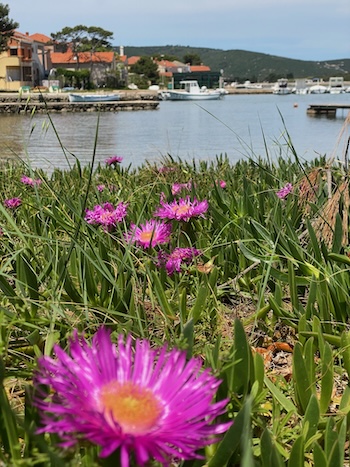 More developed is Ilovik, tucked into Losinj’s tail and known as the ‘Island of Flowers’ for its own abundance of oleander, rose and eucalyptus. Heading back up the coast to Mali Losinj, I find it remarkable that a stretch of the Mediterranean this handsome hasn’t been given over to wall-to-wall hotels. What stays with me most is the colour of the water — the Adriatic has a shade of blue entirely its own.
A hundred yards up the promenade, in some contrast to Alhambra, sits the larger, more contemporary Bellevue. Here, in the spirit of the sea’s bounty, we dine at Matsunoki, the group’s award-laden Japanese restaurant. After a run of tasting starters — Kobe beef fukuju, beef tataki with truffle mayonnaise, duck gyoza, tuna tartare — comes a sashimi course of remarkable range: sea bass, a volcano tuna roll, golden dragon, wagyu asparagus, plus salmon, hamachi and tuna sashimi, alongside an exquisite 40%-polished Fukujo ‘blue’ sake. Ironically, for all that dazzling fish, the highlight turns out to be the simplicity of a miso ice cream for dessert, even upstaging the strudel-like apple gyoza it accompanies.
It’s hard to leave Alhambra without feeling that the whole place is, in some sense, still practising what those nineteenth-century botanists preached. The pines that shelter it, the sea that laps at its jetty, the very air one is encouraged to breathe more deeply — none of it is incidental; it’s the point, and has been for well over a century. Other hotels borrow the language of wellness. Alhambra simply inherited it, along with the villas, the woodland and the view. A heritage of healing, a legacy of luxury, as they put it themselves — and, for once, the strapline undersells it. I came in search of nothing more than a good story and a decent dinner. I left rather wondering whether I’d been cured of something I hadn’t known was wrong with me.
For more information about Boutique Hotel Alhambra, including details of other properties in the portfolio, please visit www.boutiquehotelalhambra.com.
And for a deeper dive into breathing therapies and their spa’s signature Seatox programme, have a look at Anna Selby’s ‘Spa of the Month’ feature on the Bellevue here.