As The Grange Festival’s summer season draws to a close, Anna Selby catches a soaring, heart-breaking Eugene Onegin — and finds, in Ruzan Mantashyan’s Tatyana, a performance for the ages…
In a recent idle conversation, I found myself having to choose the best – or at least my favourite – soprano aria. This is no easy task. There are clearly the impressively taxing (the Queen of the Night in The Magic Flute), the show-stoppers (Carmen’s Habanera) and the simply beautiful (the Contessa’s Act II aria in The Marriage of Figaro). But in the end, I had to choose Tatyana’s letter scene in Eugene Onegin. Not only is this a tour de force for a singer (not to mention the stamina required given it’s around 15 minutes when Tatiana is entirely alone on stage), it’s a performance that needs to break your heart. You need then, not just a great soprano but a great actress.
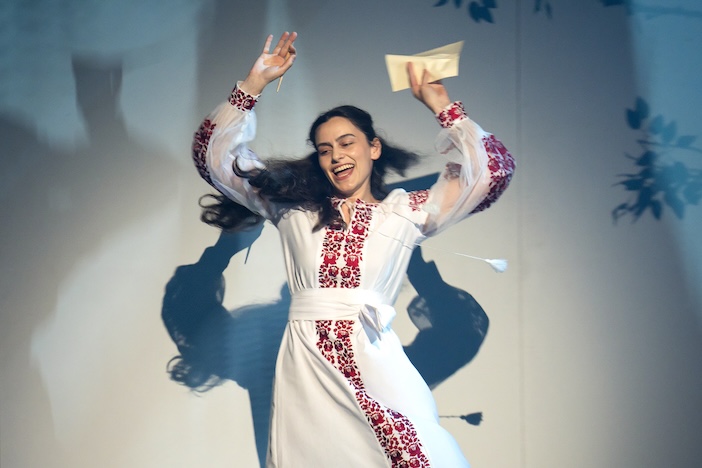
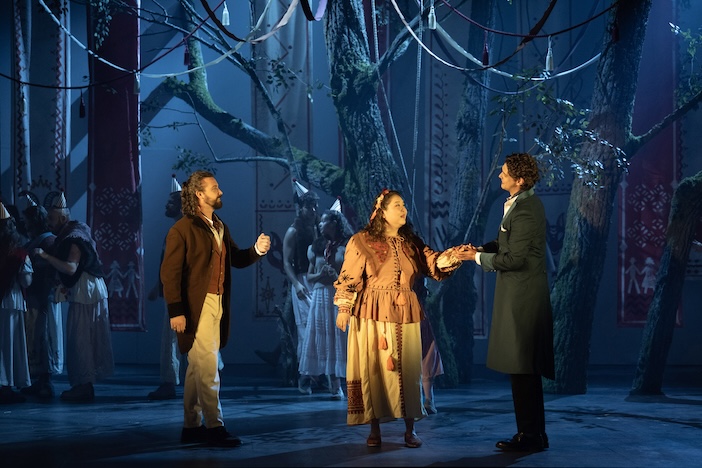
At this year’s Grange Festival, they found one. Ruzan Mantashyan is an Armenian soprano who is without a doubt the best Tatyana I’ve seen or heard. Bookish and aloof in the opening scene – the polar opposite of her exuberant sister Olga (charmingly portrayed by Alice Chung) – she explodes with youthful passion as she writes her love letter to Onegin. She makes this extraordinarily demanding scene seem utterly effortless and easily captures the audience’s heart.
Of course, she doesn’t capture Onegin’s and his high-handed rejection of the young Tatyana is his moment of folly. It comes back, of course, to haunt him. Onegin is Pushkin’s original “verse-novel” anti-hero who, bored with his high-society life in the city, has moved to the country on a whim, befriended his neighbour Lensky (an engaging Ryan Vaughan Davies) and joined him on a visit to Tatyana’s family. Moody and irritable at Tatyana’s party, he decides to irritate Lensky by flirting with his fiancée Olga – witnessed by the devastated Tatyana – and this leads inevitably to a duel. Lensky dies, Onegin flees, years pass.
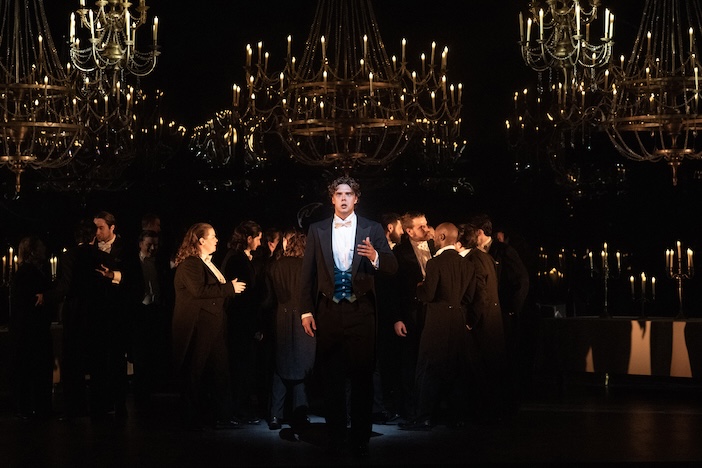
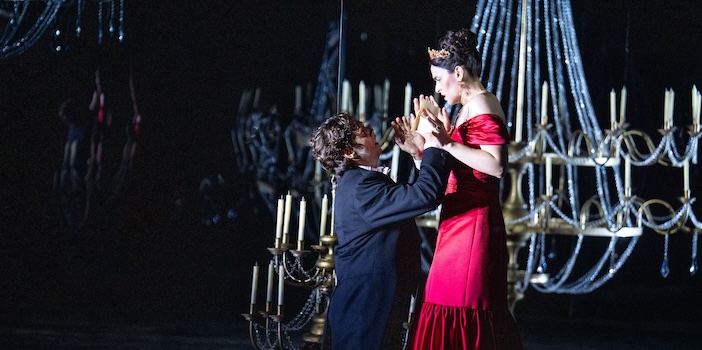
When we see him again, Onegin is at a smart ball in St Petersburg when he noticed a beautiful woman who is clearly at the centre of high society. It is, of course, Tatyana, now married to a prince (usually elderly but here the dashing Mark Kurmanbayev). He declares his love and, though she admits she still loves him, is rejected by the older, wiser Tatyana, dazzling in scarlet and as vocally impressive as ever. It is surely one of opera’s most satisfying comeuppances.
Vladislav Chizhov certainly looks the part and his thwarted passion at the end is all too believable – albeit difficult for the audience to feel much sympathy for him. There are some excellent performances in the smaller roles, particularly Diana Montague as Larina and Catherine Wyne-Rogers as Filipyevna. The chorus are in superb voice, though rather peculiar costumes and much enhanced by six dancers who, choreographed by Arthur Pita, bring a dramatic commentary to the proceedings. The Bournemouth Symphony Orchestra play magnificently under the baton of Lidiya Yankovskaya who delivers every nuance and soaring moment of Tchaikovsky’s wonderful music.
The Grange Festival, staged each summer in the grounds of Grange Park in Hampshire, may not have the name recognition of Glyndebourne, but on this evidence deserves a place among the UK’s finest country-house opera seasons. The only fly in the ointment here is that it has just drawn to a close after a very impressive season. The programme for next year is yet to be announced but, if this Onegin is anything to go by, I’d recommend booking early for this idyllically sited opera season in ’27.
For more information about the Grange Festival, please visit www.thegrangefestival.co.uk.