A night of Anglo-French rivalry on a Paris rooftop gives way to lunch at Hélène Darroze’s Marsan, where Douglas Blyde finds a restaurant with no interest in competing — only in returning, again and again, to the Landes…
The night before lunch, I found myself on a Paris rooftop helping stage another instalment of an ancient argument: England versus France. Sussex fizz against Champagne, Essex Chardonnay against Chablis, and Pinot Noir vinified in Dorset hauled before Burgundy’s magistrates, glasses raised above the city while national pride disguised itself as wine appreciation. The exercise was entertaining, occasionally illuminating, and entirely dependent on comparison.
 Marsan arrived the following day with no interest in comparison. Rue d’Assas belongs to a quieter Paris. Luxembourg Gardens are nearby, Saint-Germain drifts within reach, and the façades appear secure in their own worth. At number four sits Hélène Darroze’s Paris restaurant, not as a destination demanding attention, but as a return address. Before leaving London, a publicist with no connection to Darroze had mentioned, almost as an aside, that Marsan was perhaps under-appreciated. Useful words. They remove the halo and sharpen the appetite.
Darroze hardly lacks visibility. The fourth-generation Landes chef passed through Alain Ducasse’s Le Louis XV, built her Paris address, and carries global recognition through The Connaught. Yet Marsan feels less interested in acclaim than origin.
Then I opened the menu and discovered the first course was a wounded tree. Printed before any mention of tuna, foie gras or Armagnac is Théophile Gautier’s Le Pin des Landes, in which a pine stands in the sandy south-west, its trunk cut open so men may harvest its resin. The tree bleeds and remains upright. Gautier concludes that poets work much the same way: no wound, no poetry; no incision, no gold. Most restaurants begin with aspiration. Marsan begins with damage.
Suddenly the trunk near the entrance made sense, as did the forest image overlooking the wine room and the Armagnac stationed around the restaurant before it reached the glass. Landes had arrived before lunch had properly begun.
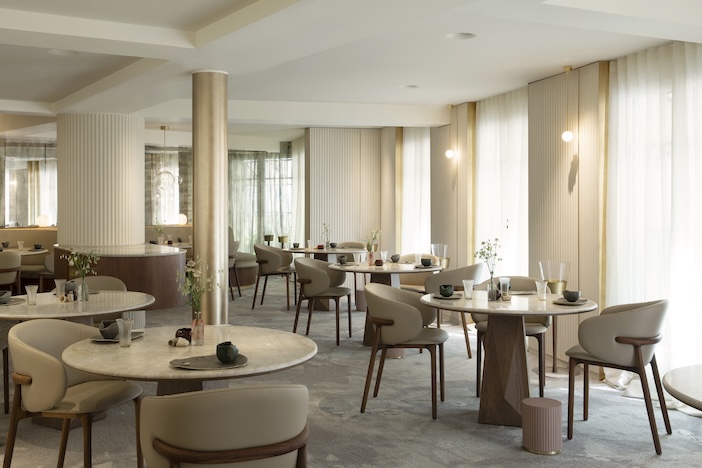
Photo by Jean Marc Palisse
Marsan, named for Mont-de-Marsan, was rebuilt in 2019 with Patrice Gardera. Oak tones, cognac colours, family objects, an open kitchen and a visible cellar create something closer to autobiography than design. Arrival upstairs brought an unexpected collective note. The kitchen brigade greeted guests in chorus, not with rehearsed exuberance, but with the confidence of a team pleased to begin service. Beyond them sat the kitchen table, one of the more compelling dining positions in Paris: close enough to observe authorship, distant enough to understand the machinery.
The dining room held guests naturally. Around me sat seasoned Parisians having lunch rather than gastronomic trophy hunters collecting evidence of a life well lived.
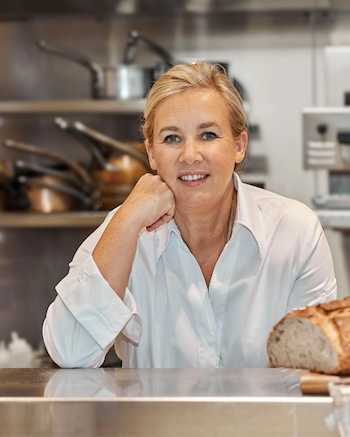 Curiously, Darroze herself never entered the dining room, which made her more visible. A great many chefs become trapped by their own presence, orbiting tables and collecting compliments. Marsan requires none of this. Darroze appeared everywhere except physically: in the forest overlooking the wine room, in the family Armagnac, in the foie gras supplied by people whose names have travelled through her cooking for decades, in the duck fat threading through the meal, and in the decision to place a wounded Landes pine at the front of the menu. The dining room did not need Darroze because the dining room already contained her.
Grégoire Girardin fitted this world perfectly. His route through Paul Bocuse, Taillevent, l’Oustau de Baumanière, Le Clarence, The Goring and Marsan has given him ease without stiffness. Thoughtful, highly trained and exact, he seemed less a sommelier playing a role than someone incapable of being anything else.
The first glass was Guiborat’s Téthys from Cramant, poured alongside duck-fat focaccia from the restaurant bakery, sourdough, butter infused with bell pepper and Guérande salt, and a bread knife curved like a boomerang. Champagne, bread and butter remain civilisation’s most persuasive triptych.
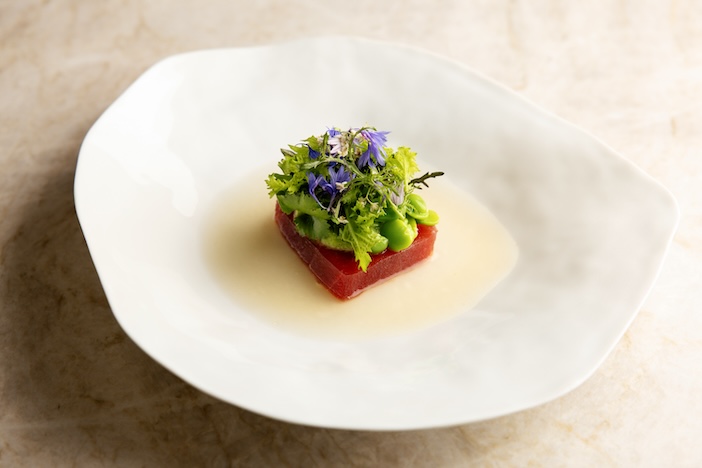
The opening sequence tightened the line. Paris mushrooms came in verbena broth, followed by crisp artichoke and anchovy bites. Then came bluefin tuna from Saint-Jean-de-Luz, a thick slice from the heart of the loin, over fresh fava-bean hummus, with trembling elderflower-vinegar jelly and raw gratings of dried tuna heart. Wittmann’s Riesling gave lift and tension. The dish seemed Basque, Japanese and entirely its own, the fish returned to itself through its own heart.
Foie gras followed from the Dupérier family in Souprosse, whose relationship with Darroze stretches across decades. The terrine arrived with melon, fennel and verjus while Domaine Vernay’s Condrieu wrapped itself around the dish with such ease it briefly made pairing appear simple. Melon is capable of humiliating wine. Here it seemed to flatter it.
The first hake course marked a shift in tone. Cooked in duck fat and served with guindillas, Cantabrian anchovies, lovage and koxkera-style sauce, it possessed a green intensity bordering on stubbornness. Etienne Bodet’s Saumur Chenin offered relief without surrender. If Marsan occasionally falters, it does so through conviction. Nothing here feels timid.
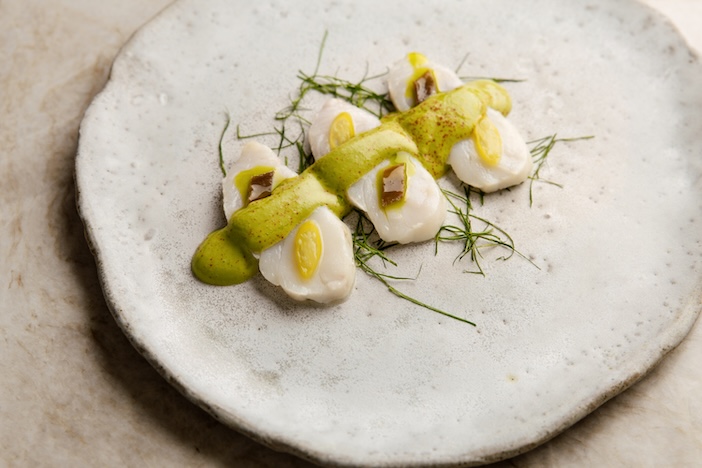
The meal’s most intriguing exchange followed: kokotxas kissed by binchotan flame with miso yolk, pil-pil, cocos de Pigna beans and Kristal caviar. Envínate’s Tenerife Listán brought volcanic energy to the conversation. France remained the grammar. It was not the whole sentence.
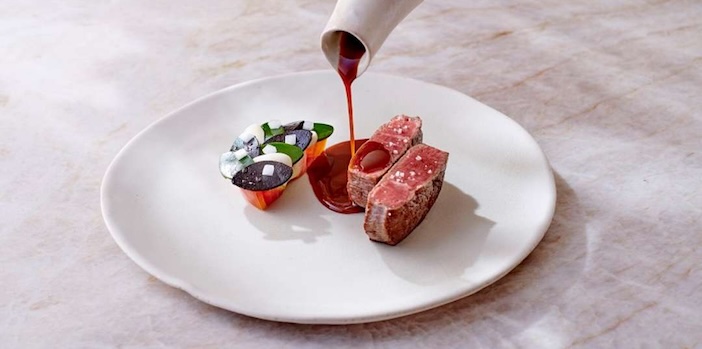
The Pyrenean Axuria lamb provided the afternoon’s deepest register. Saddle and rack were roasted and finished over wood fire, shoulder was confited, and turnips arrived with caper leaves and a jus sharpened by ras el hanout, lime and caper oil. Girardin first reached for Piedrasassi from California before introducing Rostaing’s Côte-Rôtie Ampodium. The Rhône bottle spoke more fluently. The lamb answered in smoke.
Cheese was served from cloches topped by small rat figures. Darroze’s connection to Colette, the sharp-edged cook in Ratatouille, has long since entered culinary folklore, yet the reference landed as affectionate rather than promotional. The Basque cheeses carried considerably more force than the wink surrounding them.
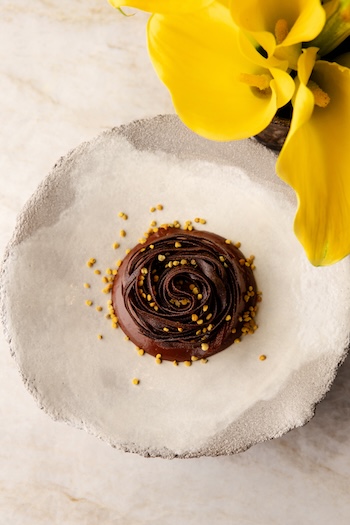 Dessert moved from discipline into something stranger. Fresh herbs animated almond ice cream, yoghurt meringue and Chartreuse foam while Huet’s Haut-Lieu Vouvray brought wax and breadth. Then came the signature baba, soaked with Bas-Armagnac Darroze 1999 – from the family cellars, and from the year Darroze first opened on Rue d’Assas – accompanied by rhubarb in marmalade, sorbet and raw ribbons. By then the pine had never really left. It was in the forest imagery, the family suppliers, the foie gras, the duck fat, the Armagnac and the persistent pull of the Landes upon every corner of the meal.
Most chefs spend their careers moving away from where they began. Darroze appears increasingly interested in travelling in the opposite direction. The wounded pine in Gautier’s poem yields resin because it has been opened. Marsan works similarly. Family, geography and tradition are cut into, distilled, clarified and returned in another form.
The previous evening had been spent on a Paris rooftop comparing England and France. Marsan seemed uninterested in the contest. Trees do not compete with one another. They grow where they are planted. The wounded pine at the front of the menu had been bleeding for a very long time. So, in its own way, had Marsan. One yielded resin. The other yielded lunch. Both had learnt that the deepest flavours arrive through the cut.
Marsan, 4 Rue d’Assas, 75006 Paris; +33 1 42 22 00 11. For more information, and for bookings, please visit www.marsanhelenedarroze.com.
Photos@desprezmarie.studio